growth · June 29, 2026
Ipamorelin Selectivity in Growth Hormone Secretagogue Models
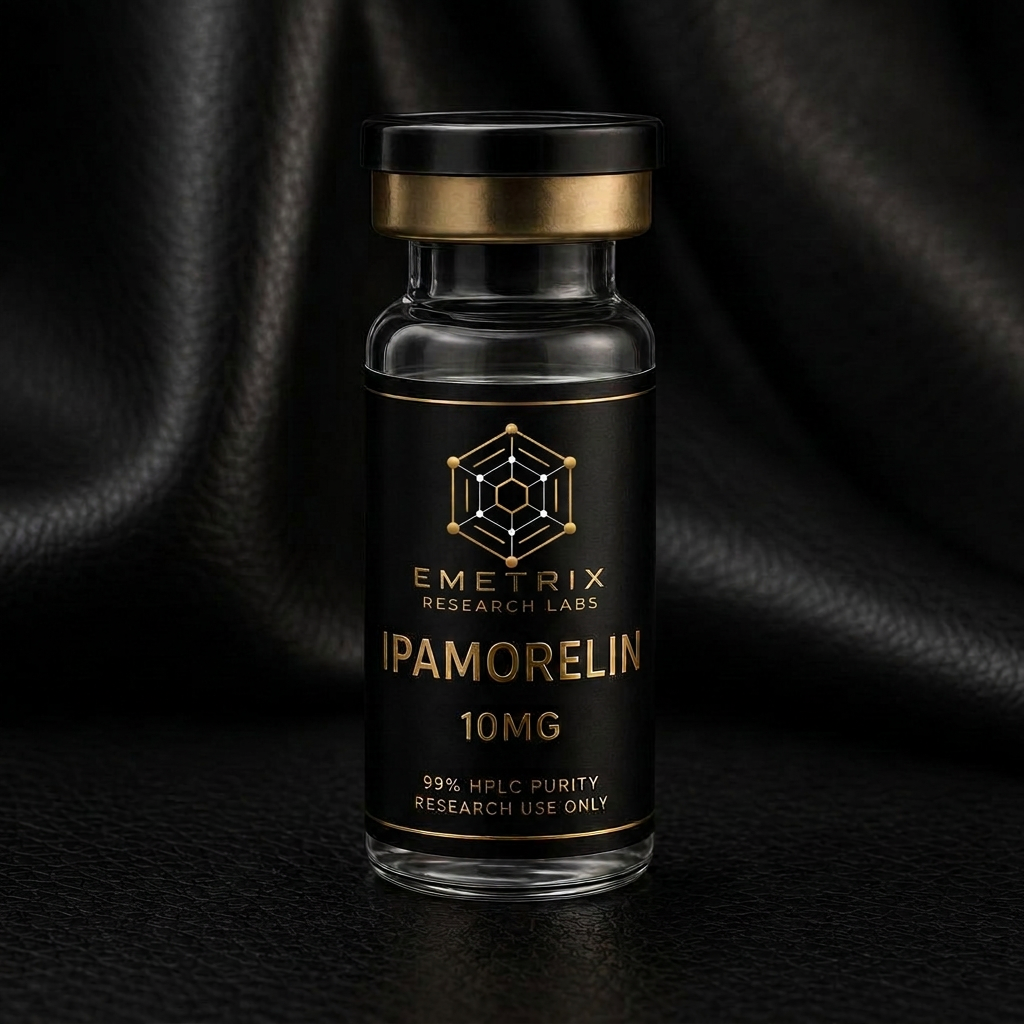
Ipamorelin is commonly used as a selective growth hormone secretagogue in preclinical endocrine research. Its value lies in separating ghrelin receptor-mediated GH release from broader pituitary-adrenal and prolactin-associated effects observed with earlier peptidyl secretagogues.

Context within GH secretagogue research
Ipamorelin is a synthetic pentapeptide growth hormone secretagogue developed within the broader class of ghrelin receptor agonists. In laboratory research, it is used to probe growth hormone (GH) release pathways with an emphasis on selectivity. The compound is structurally distinct from endogenous ghrelin, yet it engages the growth hormone secretagogue receptor 1a (GHSR1a), a G protein-coupled receptor expressed in pituitary somatotrophs and hypothalamic regulatory networks.
The principal research interest in ipamorelin is not simply that it can stimulate GH release in experimental systems. Earlier secretagogues, including GHRP-6, GHRP-2, and hexarelin, also produce robust GH responses in animal and cellular models. Rather, ipamorelin became notable because investigators observed a comparatively narrower endocrine profile, with less apparent activation of adrenocorticotropic hormone (ACTH), cortisol or corticosterone, and prolactin pathways under several experimental conditions. This selectivity has made it useful for experiments that require GH-axis stimulation while minimizing confounding activation of adjacent pituitary axes.
Receptor pharmacology and signaling considerations
GHSR1a is the canonical receptor through which ghrelin and many synthetic GH secretagogues act. Upon activation, the receptor couples primarily through Gq/11-associated signaling, promoting phospholipase C activation, intracellular calcium mobilization, and downstream secretory events in somatotroph populations. In pituitary-derived cell systems and ex vivo preparations, this signaling can culminate in GH release, particularly when somatotrophs are competent and appropriately primed by endogenous regulatory factors.
Ipamorelin is often described as a GHSR agonist with relatively high functional selectivity for GH release. The term “selectivity” here should be interpreted operationally. It reflects the profile observed across receptor assays, endocrine readouts, and comparative secretagogue studies, not an absolute restriction of activity to a single cell type or physiological endpoint. GHSR1a is expressed in multiple tissues and neural populations in research models, and ghrelin receptor biology includes constitutive activity, receptor heterodimerization, and context-dependent signaling bias. These features complicate simple classifications.
A useful experimental distinction is between receptor-level selectivity and endocrine-output selectivity. A compound may bind and activate GHSR1a yet differ in its downstream endocrine consequences depending on dose range, model species, route of administration in animal studies, sampling schedule, and the state of hypothalamic-pituitary feedback loops. Ipamorelin’s reputation rests largely on the latter: it tends to produce GH release with reduced collateral elevations in ACTH and prolactin compared with some earlier secretagogues in preclinical systems.
Comparisons with earlier peptidyl secretagogues
GHRP-6 and GHRP-2 provided foundational tools for identifying and characterizing the GH secretagogue receptor system. However, these compounds have frequently been associated with broader endocrine responses in preclinical studies. Investigators have reported stimulation of ACTH and prolactin under certain conditions, suggesting activity beyond a narrowly somatotropic endpoint. Hexarelin, another potent peptidyl secretagogue, has also shown strong GH-releasing capacity but may produce endocrine and cardiovascular findings that complicate interpretation in some experimental designs.
Ipamorelin was developed partly to improve this pharmacological profile. Comparative studies in animal models have indicated that ipamorelin can stimulate GH release while producing smaller changes in ACTH, cortisol or corticosterone, and prolactin than several comparator peptides. This difference is important when GH is the dependent variable of interest and when glucocorticoid or prolactin shifts would introduce confounding effects on metabolism, immune signaling, or tissue growth readouts.
The comparison should not be overstated. Secretagogue responses vary by species, sex, age, nutritional state, stress exposure, and experimental handling. GH secretion itself is pulsatile and highly sensitive to sampling timing. A peptide that appears selective in one protocol may show a more complex endocrine signature under another. For this reason, ipamorelin is best viewed as a comparatively selective research reagent rather than as a perfectly isolated GH-axis switch.
Experimental applications in growth models
In growth-related research, ipamorelin has been used to examine how episodic GH secretagogue stimulation influences downstream endocrine and tissue markers in preclinical systems. Typical endpoints include circulating GH in animal studies, insulin-like growth factor 1 (IGF-1) expression or concentration, hepatic GH-responsive gene expression, chondrocyte activity in growth plate models, and changes in body composition or lean mass proxies in controlled laboratory settings.
Its selectivity is particularly relevant in designs where investigators seek to separate GH-mediated effects from stress-axis activation. Glucocorticoids can independently alter glucose handling, protein turnover, immune tone, and skeletal growth parameters. Prolactin can also affect metabolic and reproductive endpoints. By reducing these off-target endocrine signals relative to older secretagogues, ipamorelin may help clarify whether observed effects are plausibly downstream of the somatotropic axis.
Cellular studies may use GHSR-expressing systems to assess receptor activation, calcium flux, beta-arrestin recruitment, or transcriptional responses. Pituitary cultures and hypothalamic explants can help distinguish direct somatotroph effects from hypothalamic mediation, although intact in vivo models remain necessary for evaluating pulsatility and feedback. In each case, the compound’s value is greatest when paired with appropriate receptor antagonists, comparator secretagogues, and time-resolved hormone measurement.
Methodological cautions and interpretation
Several limitations should guide interpretation. First, GH assays are highly time dependent. A single sampling point may miss peak release or mischaracterize pulse amplitude. Serial sampling, where feasible in animal models, provides a more accurate view of secretagogue dynamics.
Second, GH and IGF-1 should not be treated as interchangeable endpoints. GH release may be acute and pulsatile, whereas IGF-1 reflects integrated hepatic and peripheral signaling over longer intervals. A compound can generate a detectable GH pulse without producing a proportionate downstream IGF-1 change, especially if nutritional status, inflammatory state, or hepatic responsiveness differs across groups.
Third, selectivity claims require comparator design. Reporting that ipamorelin increased GH without measuring ACTH, corticosterone, cortisol, or prolactin does not establish endocrine selectivity. Stronger studies include older secretagogues, vehicle controls, receptor blockade, and multiple endocrine markers across relevant time points.
Fourth, GHSR biology is not confined to GH release. Ghrelin receptor signaling intersects with appetite regulation, glucose metabolism, gastrointestinal motility, autonomic tone, and reward-related neural circuits in research models. Even a comparatively selective GH secretagogue may produce non-somatotropic effects depending on exposure conditions and tissue context.
Research significance
Ipamorelin occupies a useful niche in GH secretagogue research because it allows investigators to interrogate the somatotropic axis with a cleaner endocrine profile than many earlier peptidyl agonists. Preclinical studies suggest that its GH-releasing activity can be experimentally dissociated, at least in part, from the ACTH, glucocorticoid, and prolactin responses that complicate interpretation of older compounds.
The most defensible conclusion is measured: ipamorelin is a comparatively selective GHSR-mediated research tool for studying GH release and downstream growth-axis biology in laboratory models. Its selectivity is empirical, context dependent, and best established through rigorous endocrine profiling rather than assumed from compound identity alone.
Related products