regenerative · July 2, 2026
BPC-157 Research Overview: Tissue Repair Signaling in Preclinical Models
A laboratory research overview of BPC-157, including mechanism, reported findings, and areas of ongoing investigator interest.

Background
BPC-157 is a synthetic pentadecapeptide that has attracted sustained interest in preclinical biomedical research due to its reported activity across diverse tissue-injury and repair models. The sequence is commonly described as being derived from a larger gastric protein fraction, and much of the early scientific interest emerged from gastrointestinal protection and wound-healing investigations. Over time, research attention expanded to musculoskeletal, vascular, neurological, inflammatory, and organ-protection models.
Unlike many peptide candidates that are studied primarily within a single receptor pathway or disease model, BPC-157 has been investigated as a broadly cytoprotective and pro-reparative compound. This breadth has made it a frequent subject in exploratory studies examining tissue resilience, vascular integrity, extracellular matrix remodeling, and stress-response biology. While the compound remains a research peptide and is not approved for clinical use, the preclinical literature has generated considerable investigator interest in its mechanisms and potential biological relevance.
Molecular and Structural Notes
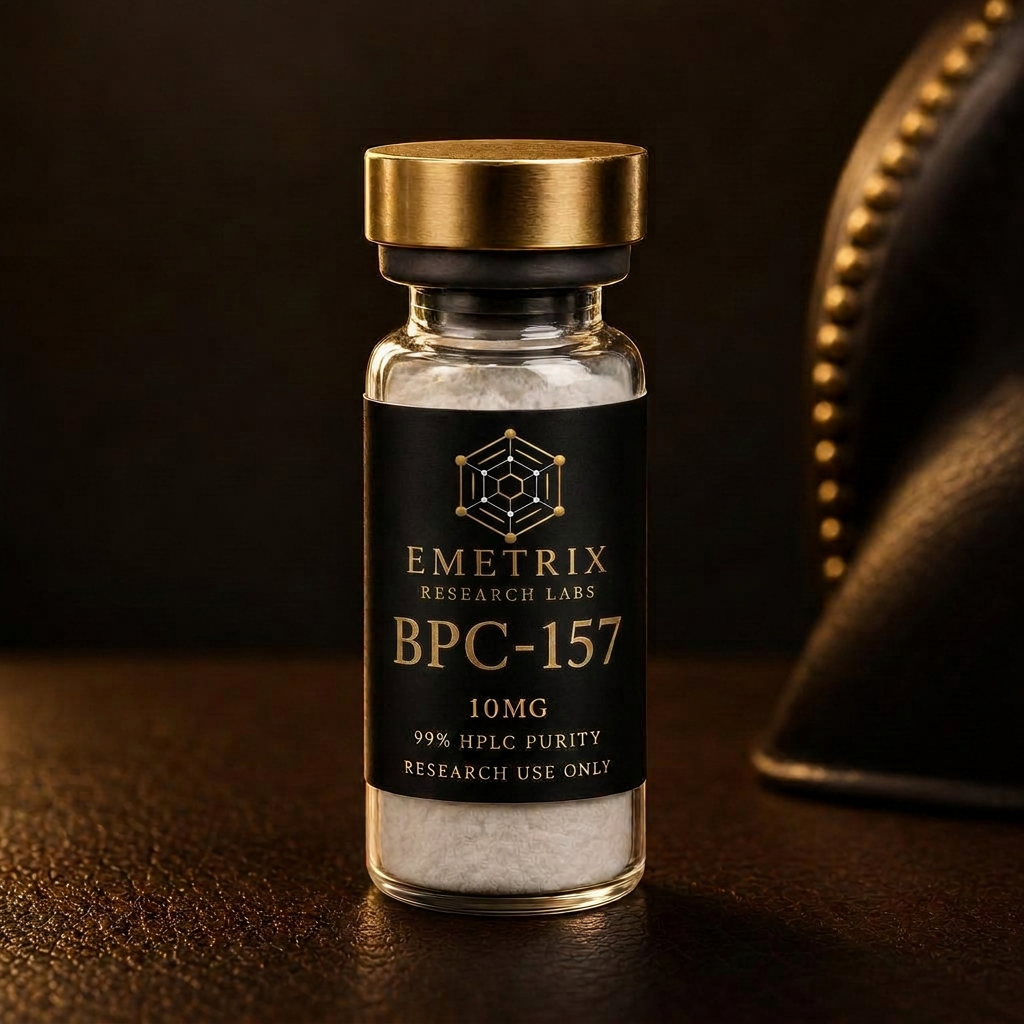
BPC-157 consists of 15 amino acids and is typically supplied for laboratory research as a lyophilized peptide. Its relatively short sequence and linear structure distinguish it from larger folded proteins, while its reported stability under certain experimental conditions has contributed to its popularity in laboratory settings. Researchers often examine BPC-157 in relation to peptide signaling, local tissue microenvironment modulation, and injury-response networks rather than as a classical hormone-like ligand with a fully established receptor profile.
A notable feature of BPC-157 research is the recurring observation that its effects appear in multiple tissue types. This has led investigators to consider whether the peptide acts through conserved repair-associated pathways, such as vascular signaling, nitric oxide regulation, cell migration, and inflammatory balance. Its structural simplicity also makes it a practical subject for peptide-handling studies, formulation screening, and comparative assays involving other small bioactive peptides.
Mechanism of Action
The precise primary molecular target of BPC-157 has not been conclusively defined, and mechanistic interpretations remain based largely on preclinical and experimental findings. Several recurring themes have emerged, however. One major area of interest is vascular regulation. BPC-157 has been associated in laboratory models with modulation of nitric oxide-related signaling, endothelial function, and angiogenic responses. These observations are relevant because blood flow, endothelial stability, and microvascular repair are central to tissue recovery after injury.
Another frequently discussed mechanism involves cellular migration and adhesion. In vitro research has suggested that BPC-157 may influence fibroblast behavior, tendon cell activity, and endothelial cell movement, potentially through pathways linked to focal adhesion dynamics and cytoskeletal organization. These processes are important in wound closure, matrix deposition, and structural remodeling.
Inflammatory modulation is also a recurring theme. Experimental models have reported changes in markers associated with oxidative stress, cytokine activity, edema, and tissue infiltration. Rather than acting as a simple anti-inflammatory agent, BPC-157 is often discussed as a compound that may support a more organized repair response, allowing inflammation to resolve while preserving necessary regenerative signaling.
Reported Research Findings
Preclinical research findings involving BPC-157 are broad and generally positive across several model systems. In gastrointestinal models, the peptide has been investigated for effects on mucosal integrity, ulcer-like lesions, and epithelial repair. These studies are central to the compound’s research identity and continue to inform interest in barrier protection and local tissue defense.
In musculoskeletal research, BPC-157 has been examined in tendon, ligament, muscle, and bone-injury models. Reported findings commonly include improved structural organization, enhanced cellular migration, and more favorable histological markers of repair compared with untreated controls. These observations have made the peptide a point of interest in studies focused on connective tissue remodeling and the biology of mechanically stressed tissues.
Vascular and soft-tissue injury models have also produced notable findings. Investigators have reported effects consistent with improved microcirculatory function, vascular rescue, and accelerated wound closure in experimental systems. Such data have encouraged further exploration of BPC-157 in relation to endothelial signaling and angiogenesis.
Additional preclinical work has explored neurological, hepatic, pancreatic, and cardioprotective contexts. In these areas, BPC-157 is generally studied as a modulator of injury response, oxidative stress, and tissue survival under experimentally induced stress. While these findings remain early and model-dependent, they support the view that BPC-157 may interact with fundamental repair and adaptation pathways.
Areas of Ongoing Investigation
Current investigator interest centers on clarifying how BPC-157 produces effects across apparently unrelated tissues. Key questions include whether the peptide interacts with a specific receptor, acts through membrane-associated signaling complexes, or influences downstream repair pathways indirectly through vascular and inflammatory regulation. Establishing a more complete pharmacological map remains an important research priority.
Another area of interest is comparative tissue specificity. Researchers continue to examine why certain injury models appear particularly responsive and whether outcomes depend on timing, local microenvironment, degree of vascular disruption, or inflammatory state. Studies using cell culture, organoid systems, and controlled injury models may help separate direct cellular effects from systemic or vascular contributions.
There is also growing interest in the relationship between BPC-157 and extracellular matrix remodeling. Tendon, ligament, and skin-repair models suggest possible relevance to collagen organization and fibroblast activity, but the specific signaling events remain under investigation. Likewise, neurological and stress-response models have prompted questions about interactions with neurotransmitter systems, autonomic regulation, and neurovascular coupling.
Analytical characterization is another active laboratory concern. Peptide purity, identity confirmation, aggregation behavior, and solution stability can influence reproducibility. As BPC-157 research expands, careful experimental controls and transparent peptide characterization will be important for interpreting results across laboratories.
Handling and Stability Considerations
As with other research peptides, BPC-157 should be handled using appropriate laboratory procedures to preserve integrity and minimize contamination. Lyophilized material is commonly stored under cold, dry, and protected conditions until use. Reconstitution practices vary by experimental protocol, but investigators generally seek to minimize repeated freeze-thaw cycles, prolonged exposure to room temperature, and contact with conditions that may promote degradation.
Because peptide behavior can be influenced by solvent composition, pH, concentration, and storage duration, researchers should validate handling conditions for their specific assay systems. For quantitative experiments, aliquoting reconstituted material and using consistent preparation timelines can improve reproducibility. Analytical confirmation by methods such as mass spectrometry or chromatographic purity assessment may be valuable when experimental outcomes are sensitive to peptide quality.
Laboratories should also consider adsorption losses, particularly at low concentrations, and should select compatible tubes, buffers, and assay conditions accordingly. Documentation of lot information, preparation method, storage conditions, and use interval is recommended for well-controlled research workflows.
Outlook
BPC-157 remains a compelling research peptide because of the consistency with which preclinical studies associate it with tissue protection, vascular support, and repair-related processes. Its broad experimental profile has encouraged investigation across gastrointestinal, musculoskeletal, vascular, inflammatory, and neurological models. At the same time, major mechanistic questions remain unresolved, especially regarding primary molecular targets, pathway specificity, and translation beyond controlled laboratory systems.
For researchers, the peptide’s value lies in its ability to probe fundamental injury-response biology. Future studies using modern molecular profiling, defined cell systems, and rigorous analytical controls may clarify whether BPC-157 represents a pathway-specific modulator, a broader cytoprotective signal, or a useful experimental tool for studying coordinated tissue repair.
Content is for laboratory research purposes only, not for human use.
Related products