growth · June 26, 2026
CJC-1295 DAC and Prolonged GHRH Analog Exposure
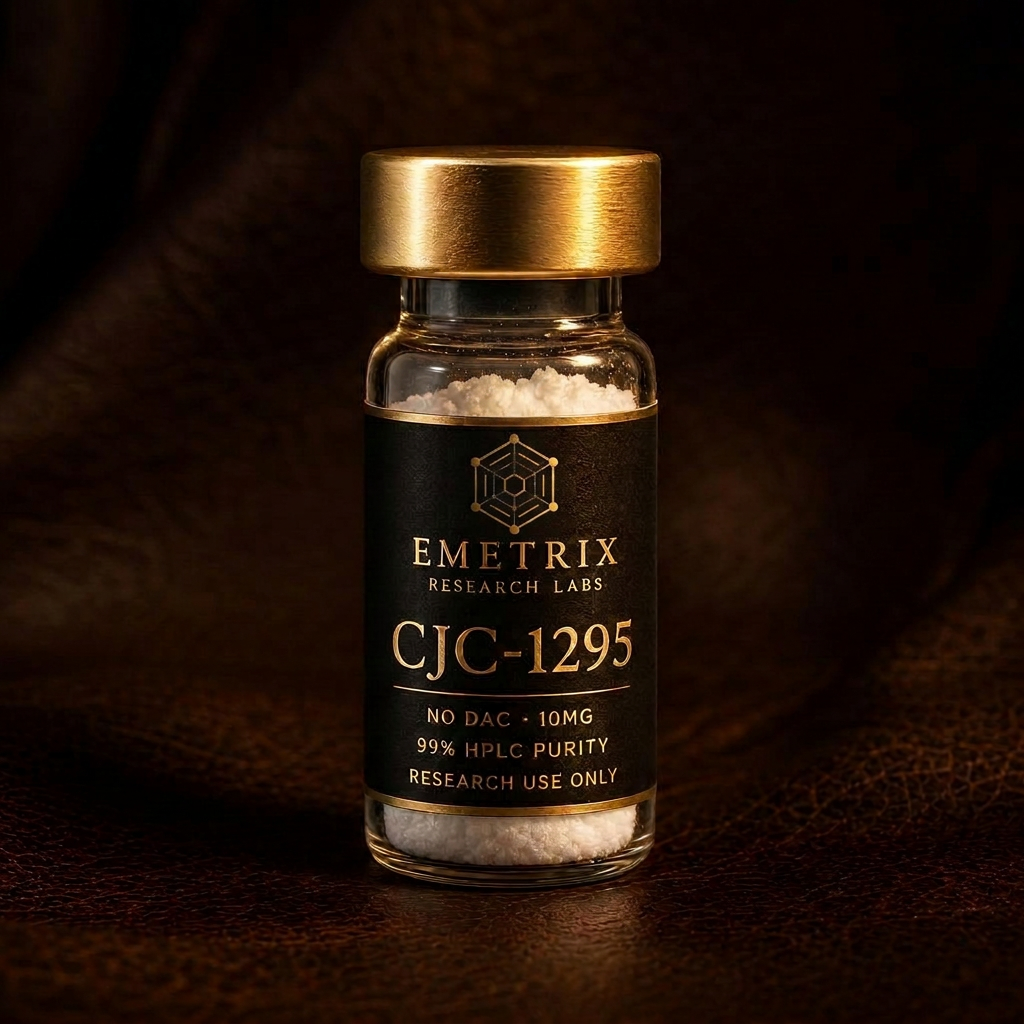
CJC-1295 is a synthetic growth hormone-releasing hormone analog engineered to extend exposure through a drug affinity complex. In preclinical and analytical models, the DAC strategy illustrates how covalent albumin association can alter peptide persistence, receptor engagement, and experimental design.
Context within growth-axis research
CJC-1295 is a modified analog of growth hormone-releasing hormone (GHRH) developed for laboratory investigation of growth hormone secretagogue biology. Within the growth research category, it is often discussed because it separates two related questions: how strongly a GHRH analog can activate its receptor, and how long that analog remains available in a biological system. The latter question is central to the molecule’s design.
Native GHRH is rapidly degraded by peptidases and cleared from circulation in experimental systems. This short persistence can be useful for pulse-based studies, but it complicates research questions requiring sustained receptor exposure. CJC-1295 incorporates amino acid substitutions intended to improve stability and preserve GHRH receptor activity. Its most distinctive feature, however, is the drug affinity complex, or DAC, which was designed to extend apparent half-life by promoting association with serum albumin.
In research models, this design places CJC-1295 among peptide analogs that use carrier binding rather than simple sequence modification alone to change pharmacokinetic behavior. The approach is not unique to the growth axis, but it is particularly informative here because hypothalamic-pituitary signaling is highly sensitive to timing, pulse structure, and exposure duration.
The DAC concept
The DAC component of CJC-1295 is based on a reactive chemical group that can form a covalent bond with free thiol residues, most notably the cysteine-34 residue of serum albumin. Albumin is abundant, comparatively long-lived, and broadly distributed in extracellular fluid. By linking a peptide analog to albumin after administration in experimental systems, investigators can substantially reduce rapid renal clearance and proteolytic degradation.
This mechanism differs from simply increasing receptor potency. DAC does not primarily make the peptide a stronger GHRH receptor agonist at the binding site. Instead, it changes the residence time of the molecule in the system being studied. The peptide is effectively carried as part of a larger protein complex, limiting filtration and shielding it from some enzymatic processes that would otherwise shorten exposure.
From a laboratory perspective, the distinction matters. A short-lived GHRH analog can produce transient receptor stimulation, whereas an albumin-associated analog can generate prolonged availability. In growth-axis experiments, these differences may influence downstream readouts such as pituitary signaling markers, growth hormone pulse characteristics, hepatic IGF-axis gene expression, and feedback-regulated hypothalamic markers. Such outcomes should be interpreted as consequences of altered exposure kinetics as well as receptor pharmacology.
Half-life extension and experimental interpretation
Preclinical studies suggest that DAC-mediated albumin binding can extend the apparent half-life of CJC-1295 far beyond that of native GHRH or non-DAC analogs. The exact value depends on species, assay method, matrix, sampling duration, and whether measurements quantify free peptide, albumin-bound peptide, immunoreactive peptide, or downstream pharmacodynamic markers. These differences can produce substantial variation across reports.
This is a common challenge in peptide pharmacokinetics. The measured half-life of an albumin-binding peptide is not only a property of the peptide sequence. It also reflects albumin turnover, binding efficiency, linker stability, tissue distribution, and analytical recovery. In vitro plasma incubation studies may show chemical stability and albumin conjugation kinetics, while in vivo preclinical models may show a composite profile shaped by distribution, metabolism, and elimination.
For research design, the DAC modification can reduce the need for frequent exposure events in animal models, but it also complicates temporal resolution. Sustained ligand availability can blur the separation between acute receptor activation and adaptive responses. Investigators examining early signaling events may prefer shorter observation windows and assays that distinguish free from bound species. Investigators studying longer endocrine adaptation may need repeated time-course sampling to avoid treating a prolonged exposure profile as a single static state.
The central point is that DAC extension should not be interpreted merely as “more peptide for longer.” It creates a different experimental condition, in which receptor systems encounter a ligand reservoir linked to albumin dynamics.
Growth-axis signaling considerations
CJC-1295 acts through the GHRH receptor, a class B G protein-coupled receptor expressed in somatotroph cells in the anterior pituitary. In research models, GHRH receptor activation is associated with cyclic AMP production, protein kinase A signaling, and stimulation of growth hormone synthesis and secretion. Downstream, growth hormone can regulate hepatic and peripheral expression of insulin-like growth factor axis components, although responses vary by species, developmental stage, nutritional state, and experimental context.
DAC-mediated persistence may influence not only magnitude but rhythm. The growth hormone axis is physiologically pulsatile, and pulse amplitude, frequency, and trough intervals can affect downstream transcriptional programs. A prolonged GHRH analog exposure may alter these dynamics differently than a brief GHRH stimulus. Investigators have observed that secretagogue timing can change endocrine profiles even when total exposure appears similar.
This is especially relevant when CJC-1295 is compared with non-DAC GHRH analogs or with ghrelin receptor agonists. GHRH receptor agonists and ghrelin mimetics engage distinct upstream receptors, and their combined or comparative effects in research models may reflect pathway convergence at somatotroph secretion rather than identical signaling mechanisms. DAC adds another variable: prolonged ligand availability may change the apparent interaction between pathways.
Consequently, growth-related endpoints should be framed cautiously. Changes in cellular signaling, endocrine markers, tissue growth indices, or gene expression in preclinical studies do not establish clinical utility. They indicate how a modified GHRH analog behaves under defined research conditions.
Analytical and methodological issues
Studying CJC-1295 with DAC requires attention to assay specificity. Immunoassays may detect structurally related peptide fragments or albumin-bound forms depending on antibody design. Mass spectrometry-based methods can offer higher structural resolution but may require specialized sample preparation to recover conjugated species. If the research question concerns albumin conjugation itself, assays should distinguish unbound peptide, albumin-bound peptide, and degradation products.
Matrix selection also matters. In vitro buffer systems do not reproduce albumin concentration, thiol availability, competing nucleophiles, or protease activity found in plasma. Conversely, plasma studies may obscure individual degradation pathways. A staged approach—chemical stability testing, plasma conjugation assays, receptor activation assays, and then preclinical time-course experiments—can help separate mechanism from system-level response.
Species differences should be considered. Albumin structure is conserved but not identical across species, and endocrine feedback regulation differs among common laboratory models. Rodent growth hormone secretion patterns, for example, are sexually dimorphic and strongly pulsatile. These features can affect interpretation of both pharmacokinetic and pharmacodynamic data.
Controls are essential. Appropriate comparators may include native GHRH, a non-DAC GHRH analog, vehicle controls, and receptor antagonist or pathway-inhibition conditions where feasible. Without such controls, it can be difficult to assign observed effects to receptor agonism, half-life extension, albumin conjugation, or nonspecific experimental stressors.
Research significance of DAC extension
The scientific value of CJC-1295 with DAC lies in its use as a model for prolonged peptide exposure within the growth hormone-releasing hormone pathway. It demonstrates how molecular engineering can convert a rapidly cleared signaling peptide into a longer-acting research tool through albumin association. This half-life extension is not a minor formulation detail; it is a defining feature that changes experimental pharmacology.
For growth-axis research, DAC-modified CJC-1295 offers a way to examine sustained GHRH receptor stimulation, delayed endocrine adaptation, and the relationship between exposure duration and downstream growth-related markers in preclinical systems. At the same time, its prolonged profile requires careful experimental framing. Duration, sampling schedule, assay format, and species selection can materially shape conclusions.
A conservative interpretation is therefore warranted. CJC-1295 with DAC is best viewed as a laboratory instrument for interrogating peptide persistence and GHRH receptor biology, not simply as a longer-lasting version of native GHRH. Its albumin-binding design provides a useful case study in how half-life extension technologies can reshape the behavior of endocrine research peptides.
Related products