growth · June 25, 2026
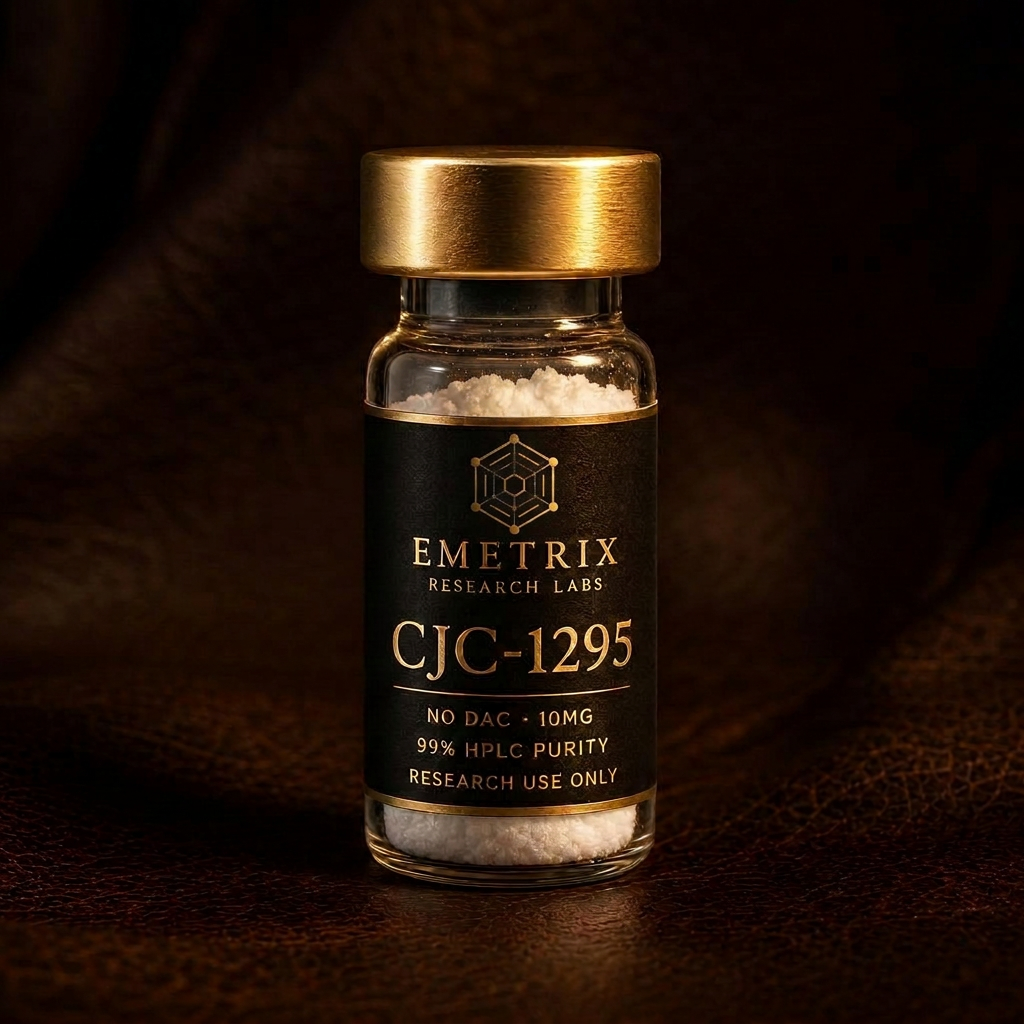
CJC-1295 in Research: Extending GHRH Half-Life for Pulsatile GH Studies
A laboratory research overview of CJC-1295, including mechanism, reported findings, and areas of ongoing investigator interest.

Background
CJC-1295 is a synthetic peptide analog of growth hormone–releasing hormone (GHRH) developed for laboratory investigation of somatotropic signaling, pituitary regulation, and peptide half-life extension strategies. In research settings, it is commonly discussed as a long-acting GHRH receptor agonist designed to stimulate pulsatile growth hormone (GH) release through upstream endocrine signaling rather than by direct GH replacement. This distinction has made the molecule of interest to investigators studying endocrine feedback loops, hypothalamic–pituitary axis dynamics, and the pharmacological modulation of secretory rhythms.
The peptide is often examined in relation to the GH/insulin-like growth factor 1 (IGF-1) axis, a regulatory network involved in growth, metabolism, tissue maintenance, and cellular repair processes across numerous experimental models. Research interest has been driven by the observation that GHRH analogs may preserve elements of physiological GH pulsatility while extending the duration of receptor engagement compared with native GHRH, which is rapidly degraded in biological systems.
Molecular and Structural Notes
CJC-1295 is based on the active N-terminal region of native GHRH, with amino acid substitutions introduced to improve resistance to enzymatic cleavage and enhance receptor activity. A defining feature of the commonly referenced CJC-1295 with drug affinity complex (DAC) is the inclusion of a reactive linker that permits covalent association with circulating albumin. This albumin-binding strategy is intended to prolong apparent circulating persistence and reduce rapid renal clearance, providing a useful model for studying peptide half-life extension.
Structurally, CJC-1295 retains features required for interaction with the GHRH receptor, a class B G protein-coupled receptor expressed primarily in somatotroph cells of the anterior pituitary. The peptide’s modifications are not merely stabilizing additions; they also provide a platform for investigating how sequence changes influence receptor binding, intracellular signaling bias, and duration of biological effect. For laboratories interested in peptide engineering, CJC-1295 represents a notable example of how analog design can combine receptor targeting with pharmacokinetic optimization.
Mechanism of Action
In experimental systems, CJC-1295 is understood to act as an agonist at the GHRH receptor. Binding to this receptor activates intracellular signaling pathways commonly associated with cyclic adenosine monophosphate production and downstream protein kinase activity. These events support transcriptional and secretory processes involved in GH release from pituitary somatotrophs.
Because CJC-1295 operates through the GHRH receptor, its activity is generally considered dependent on pituitary responsiveness and the broader endocrine environment. This makes it mechanistically distinct from direct GH administration in research models. Instead of supplying the terminal hormone, the peptide engages an upstream regulatory node, allowing investigators to observe system-level responses involving GH secretion, IGF-1 production, feedback signaling, and temporal hormone dynamics.
The albumin-binding properties of the DAC-containing form are also mechanistically important. Extended association with albumin can increase the period over which receptor-active peptide remains available, potentially producing prolonged endocrine signaling compared with short-lived releasing hormone fragments. This property has made CJC-1295 useful in studies exploring how signal duration affects endocrine output.
Reported Research Findings
Across preclinical and laboratory research contexts, CJC-1295 has been associated with increased GH release and downstream elevation of IGF-1 signaling markers. Investigators have reported interest in its ability to enhance somatotropic axis activity while maintaining a regulatory framework that still depends on pituitary function and feedback control. This has positioned the peptide as a valuable research tool for exploring endocrine amplification rather than simple hormone replacement.
Positive findings frequently emphasized in research discussions include sustained stimulation of GH-related pathways, extended duration of action relative to native GHRH, and compatibility with studies focused on pulsatile secretion biology. In animal and cell-based research models, GHRH analogs such as CJC-1295 have been examined for their effects on body composition parameters, nitrogen balance, protein turnover, bone-related signaling, and recovery-associated molecular pathways. These areas are not isolated phenomena; they reflect the broad influence of the GH/IGF-1 axis on anabolic and reparative biology.
Another theme of interest is the peptide’s utility in aging-related models. Since endogenous GH secretion often changes with age in many species, CJC-1295 has been used experimentally to probe whether upstream stimulation of the pituitary can alter molecular markers associated with tissue maintenance, metabolic regulation, and endocrine resilience. The molecule has also been discussed in relation to models of catabolic stress, where investigators are interested in how GH-axis modulation affects lean tissue preservation and systemic nutrient partitioning.
Areas of Ongoing Investigation
Current investigator interest in CJC-1295 spans several overlapping domains. One area involves endocrine rhythm modeling, particularly the relationship between sustained GHRH receptor activation and natural GH pulse architecture. Researchers continue to examine whether extended-acting GHRH analogs reinforce, reshape, or partially uncouple normal secretory timing.
A second area concerns metabolic signaling. Because the GH/IGF-1 axis intersects with lipid metabolism, glucose handling, protein synthesis, and energy expenditure, CJC-1295 remains of interest in controlled laboratory models of nutrient balance and endocrine adaptation. These investigations often focus on pathway-level responses rather than single endpoints.
A third field of study is peptide design. CJC-1295 provides a practical reference compound for examining albumin-binding technologies, linker chemistry, peptide stability, and structure–activity relationships among class B GPCR ligands. The DAC strategy in particular continues to attract attention from researchers developing long-acting peptide tools.
Investigators are also exploring combinatorial research approaches. In some laboratory settings, GHRH analogs are evaluated alongside growth hormone secretagogues that act through distinct receptors, allowing comparison of convergent endocrine outputs from different upstream mechanisms. Such work is useful for mapping receptor-specific contributions to GH release and downstream IGF-1 signaling.
Handling and Stability Considerations
As with many synthetic peptides, CJC-1295 should be handled using appropriate laboratory controls to minimize contamination, moisture exposure, and repeated temperature cycling. Lyophilized material is commonly stored under low-temperature, dry, and protected conditions until reconstitution. Once prepared in solution, peptide stability can be influenced by solvent composition, pH, concentration, microbial contamination, adsorption to surfaces, and freeze–thaw frequency.
Researchers typically prepare aliquots to reduce repeated thawing and maintain consistency across experiments. Low-binding tubes may be considered when working with dilute peptide solutions, as adsorption can contribute to variability in concentration-sensitive assays. Documentation of lot number, reconstitution conditions, storage duration, and freeze–thaw history is recommended for reproducibility.
Because CJC-1295 is biologically active in endocrine signaling models, appropriate institutional procedures should be followed for storage, preparation, disposal, and experimental use. Analytical confirmation methods such as mass spectrometry or HPLC-based assessment may be employed by suppliers or laboratories to evaluate identity and purity, depending on the intended research application.
Outlook
CJC-1295 remains a significant research peptide for laboratories investigating GHRH receptor biology, somatotropic axis regulation, and long-acting peptide design. Its combination of receptor-directed activity and half-life extension has made it especially relevant to studies seeking to understand how duration, amplitude, and timing of endocrine stimulation influence downstream biological outcomes. While many questions remain regarding optimal model systems, signaling dynamics, and long-term pathway effects, the peptide continues to provide a useful experimental framework for examining GH/IGF-1 axis modulation in controlled research environments.
Content is for laboratory research purposes only, not for human use.
Related products