regenerative · July 17, 2026
TB-500 in Experimental Tendon Repair Models
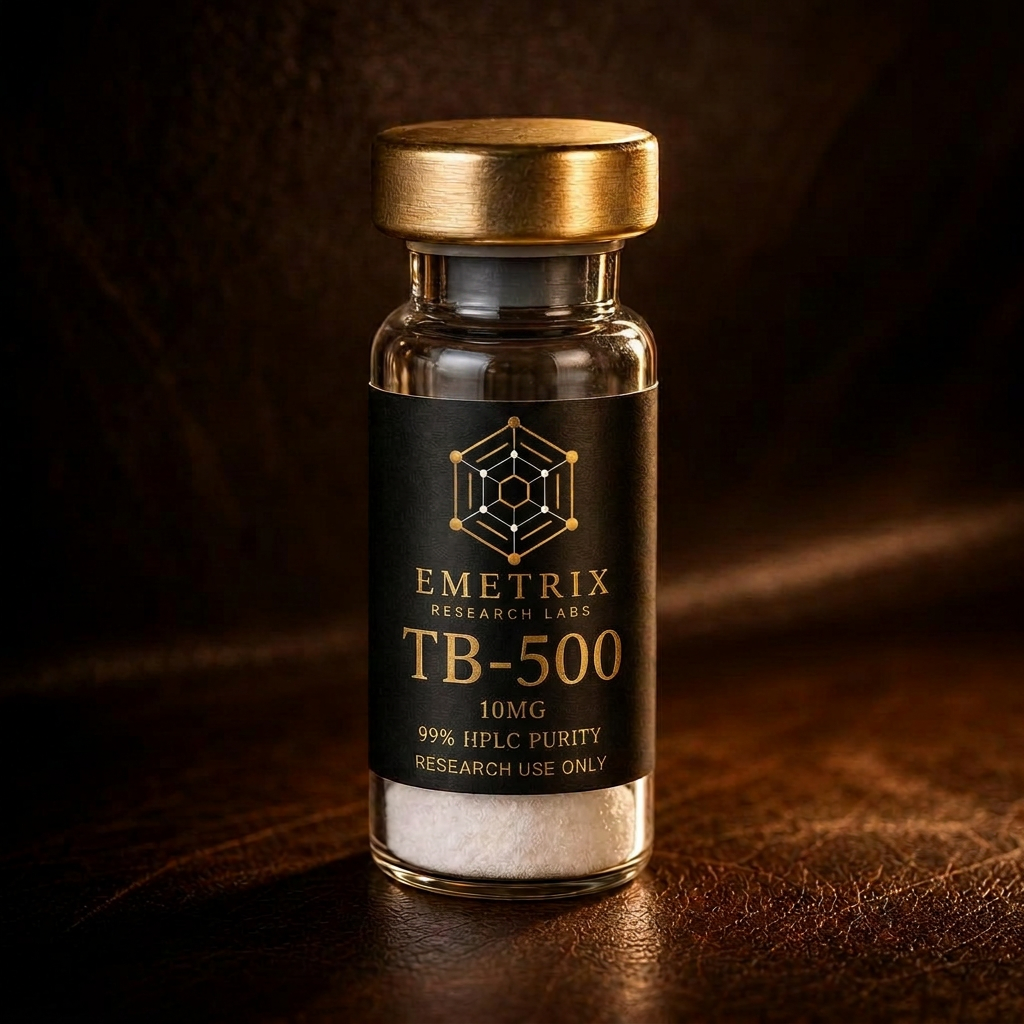
TB-500 is commonly discussed as a synthetic peptide related to thymosin beta-4, a regulator of actin dynamics and tissue repair signaling. In tendon research, its relevance centers on cell migration, extracellular matrix remodeling, angiogenic signaling, and inflammation resolution in preclinical systems.

Research context
Tendon repair remains a difficult problem in regenerative biology because tendon tissue is sparsely cellular, poorly vascularized, and mechanically specialized. After injury, the repair process often produces fibrotic scar rather than fully restored tendon architecture. Investigators therefore continue to evaluate molecular candidates that may influence tenocyte behavior, extracellular matrix organization, vascular response, and inflammatory signaling during repair.
TB-500 is generally described in research settings as a synthetic peptide associated with thymosin beta-4 biology. Thymosin beta-4 is a naturally occurring actin-binding peptide implicated in cell motility, cytoskeletal regulation, angiogenesis, and tissue remodeling. The precise identity, purity, and biological equivalence of materials labeled “TB-500” can vary across suppliers and reports, which is an important limitation when interpreting the literature. For laboratory purposes, TB-500 is best considered a research peptide whose relevance derives from proposed overlap with thymosin beta-4-associated repair pathways rather than from a well-established clinical profile.
Mechanistic rationale in tendon biology
Tendon repair requires coordinated movement and proliferation of resident tenocytes, recruitment of progenitor-like cells, controlled deposition of type I and type III collagen, and progressive remodeling under mechanical load. Thymosin beta-4-related peptides are of interest because they interact with actin regulatory systems that govern cell shape, migration, and cytoskeletal plasticity. These features are relevant to the early stages of wound closure and matrix repopulation in tendon explants and injury models.
In preclinical studies of soft tissue repair, thymosin beta-4 has been associated with increased cell migration, altered inflammatory mediator expression, and enhanced vascular signaling. Angiogenesis is a double-edged process in tendon repair: increased vascular ingrowth may support early nutrient delivery and cell recruitment, but excessive or persistent vascularity can accompany pathological remodeling. For this reason, any TB-500-related effect on vascular endothelial growth factor signaling, endothelial migration, or capillary formation should be interpreted in relation to repair phase and tissue mechanics.
Another proposed mechanism involves modulation of inflammatory response. Acute inflammation is necessary for debris clearance and initiation of repair, but prolonged inflammatory signaling can impair collagen organization and promote adhesions or scar. In research models, thymosin beta-4-associated pathways have been linked to changes in macrophage behavior, cytokine expression, and tissue remodeling enzymes. Whether TB-500 reliably reproduces these effects in tendon-specific systems remains an empirical question rather than a settled conclusion.
Findings from preclinical repair models
The tendon-specific evidence base for TB-500 is narrower than the broader literature on thymosin beta-4 in tissue repair. Investigators have used related peptides in animal injury models, cell culture assays, and soft tissue healing experiments to examine wound closure, collagen deposition, and mechanical recovery. Results from these systems suggest that thymosin beta-4-associated signaling may influence several processes relevant to tendon repair, including fibroblast-like cell migration, extracellular matrix turnover, and vascular response.
In tendon-derived cell culture systems, useful endpoints include tenocyte viability, migration in scratch assays, proliferation, expression of scleraxis and tenomodulin, and collagen gene expression. A central concern is phenotype preservation: tenocytes can drift toward a more fibroblastic or myofibroblastic state in culture, particularly under serum-rich or mechanically static conditions. Any apparent increase in cell number or migration must therefore be evaluated alongside markers of tendon lineage and matrix quality.
In explant or animal tendon injury models, histological organization is more informative than gross closure alone. Investigators typically assess collagen fiber alignment, cellularity, vascular density, inflammatory infiltrate, and adhesion formation. Biomechanical testing—such as tensile strength, stiffness, and failure load—is essential because a histologically thicker repair does not necessarily represent a functionally superior tendon. Preclinical studies suggest that thymosin beta-4-related interventions can alter repair dynamics in several tissues, but tendon outcomes may depend heavily on injury type, loading environment, timing of exposure, and local tissue context.
Matrix remodeling and mechanical considerations
Tendon function depends on hierarchical collagen structure, from fibrils to fascicles, aligned along the axis of load. Regenerative strategies that accelerate early matrix deposition may not improve final mechanical quality if collagen is disorganized or if remodeling is incomplete. For TB-500 research, this distinction is central. A peptide that increases migration or provisional matrix formation may improve early histological appearance while still requiring mechanical conditioning to produce mature tendon architecture.
Matrix metalloproteinases, lysyl oxidase activity, collagen crosslinking, and the ratio of type I to type III collagen are important endpoints for assessing repair quality. Type III collagen is often elevated during early healing and scar formation, whereas mature tendon is dominated by type I collagen. Investigators studying TB-500 in tendon models should therefore examine temporal patterns rather than relying on single time-point measurements.
Mechanical loading also shapes the interpretation of peptide effects. Tendon cells are mechanosensitive, and loading can regulate collagen synthesis, alignment, and catabolic signaling. A candidate repair peptide may produce different outcomes under immobilized, freely moving, or controlled-loading conditions. For this reason, experimental designs should report mechanical environment with the same rigor as peptide exposure conditions.
Experimental design cautions
A recurring challenge in TB-500 research is reagent characterization. Materials described by this name may not be identical to full-length thymosin beta-4, and may differ in sequence, formulation, stability, and impurity profile. Laboratory studies should include analytical confirmation where possible, such as mass spectrometry or HPLC-based purity assessment. Without this, reproducibility is difficult and mechanistic attribution becomes uncertain.
Controls are also important. Studies should distinguish effects on general fibroblast proliferation from tendon-specific repair processes. Comparative arms using full-length thymosin beta-4, inactive sequence controls, or scrambled peptides can help determine whether observed responses are sequence-specific. In cell-based systems, serum concentration, passage number, substrate stiffness, oxygen conditions, and inflammatory stimulation can all alter readouts.
Researchers should avoid overinterpreting gross healing metrics. Tendon repair quality requires convergent evidence from histology, molecular markers, imaging, and biomechanics. Claims of regeneration should be reserved for cases where repaired tissue demonstrates organized collagen architecture and mechanical properties approaching uninjured tendon in the relevant model. At present, the most defensible framing is that TB-500 is a candidate tool for probing thymosin beta-4-related repair biology in preclinical tendon systems.
Outlook
TB-500 occupies an interesting but not fully resolved position in regenerative tendon research. Its proposed connection to thymosin beta-4 pathways gives it a plausible mechanistic basis: actin dynamics, cell migration, angiogenic signaling, and inflammatory modulation are all relevant to tendon repair. However, tendon regeneration is not simply accelerated wound closure. The field needs standardized reagents, tendon-specific models, longitudinal matrix analysis, and rigorous biomechanical testing.
Future studies would benefit from comparing TB-500-related materials directly with well-characterized thymosin beta-4 preparations, mapping dose-response relationships in vitro, and evaluating timing-dependent effects across inflammatory, proliferative, and remodeling phases in animal models. Until such data are more consistent, TB-500 should be treated as an experimental peptide for investigating repair-associated pathways, not as an established regenerative intervention.
Related products