regenerative · July 16, 2026
GHK-Cu Overview: Copper Tripeptide Signaling in Regenerative Research
A laboratory research overview of GHK-Cu, including mechanism, reported findings, and areas of ongoing investigator interest.
Background
Glycyl-L-histidyl-L-lysine copper complex, commonly abbreviated GHK-Cu, is a naturally occurring tripeptide–metal complex that has attracted sustained interest in biochemical, cell biology, and tissue-model research. The parent peptide GHK is composed of glycine, histidine, and lysine and is capable of coordinating copper ions through donor atoms within the peptide backbone and side chains. In research settings, the copper-bound form is often examined because copper is an essential transition metal involved in numerous enzymatic and redox-associated biological processes.
Investigators have studied GHK-Cu primarily in the context of extracellular matrix regulation, dermal and epithelial biology, wound-model systems, inflammatory signaling, and age-associated changes in cellular function. The compound is of interest because it appears to combine a compact peptide scaffold with metal-binding properties that may influence copper availability, gene expression patterns, and cell–matrix interactions in experimental systems.
Molecular and Structural Notes
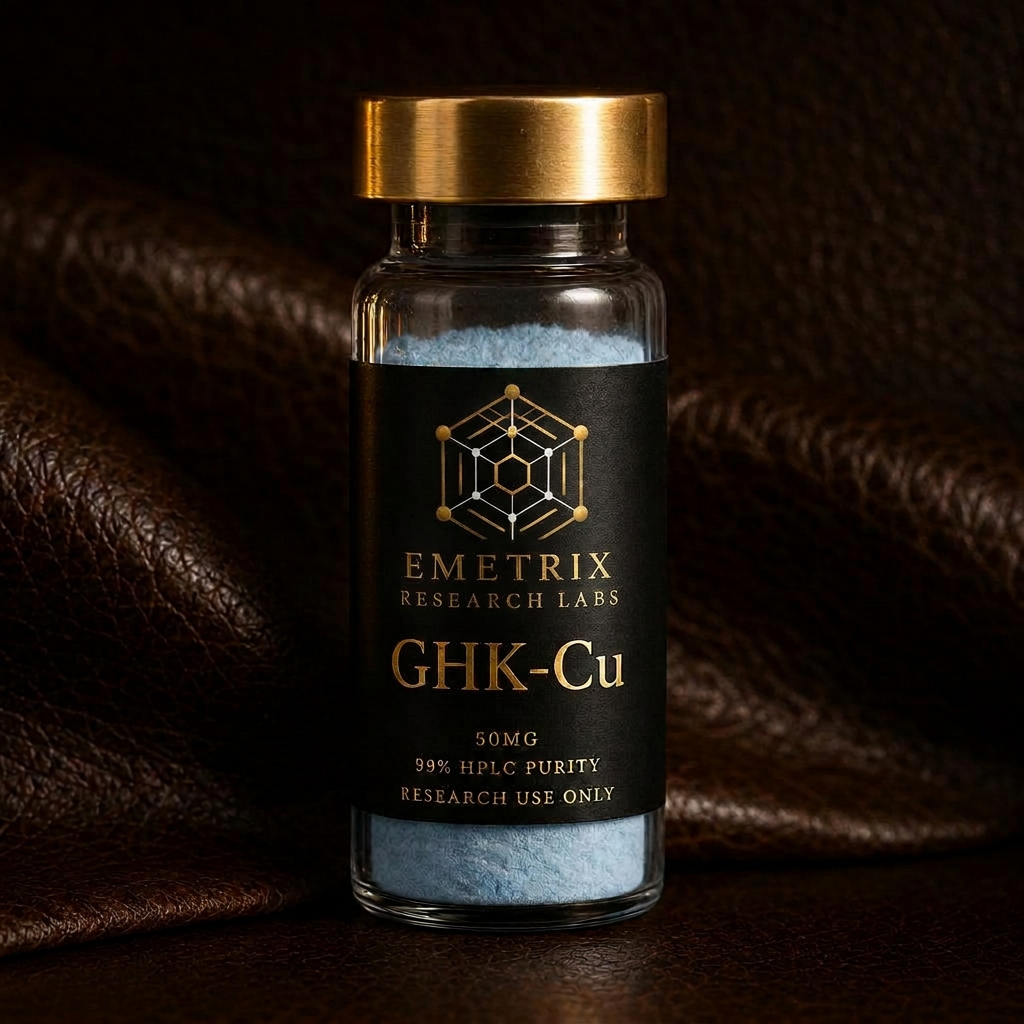
GHK is a small, water-soluble tripeptide with the sequence Gly-His-Lys. The imidazole group of histidine provides an important coordination site for copper binding, while the terminal amino group and peptide nitrogen atoms may contribute to complex formation depending on pH, ionic conditions, and formulation. The resulting GHK-Cu complex is typically described as a blue-colored copper peptide, reflecting copper coordination chemistry.
From a laboratory standpoint, GHK-Cu is often handled as a research-grade peptide complex rather than as a simple unbound peptide. Its behavior may be affected by buffer composition, competing chelators, reducing agents, pH, and the presence of metal-binding proteins or salts. These variables can influence free copper availability, complex stability, and downstream assay interpretation. For this reason, researchers commonly design experiments with appropriate vehicle controls, copper-only controls, and peptide-only comparisons when evaluating biological effects.
Mechanism of Action
The mechanisms attributed to GHK-Cu are best understood as multifactorial and context-dependent. One central theme is copper coordination and delivery. Copper is required by several enzymes involved in connective tissue formation, oxidative metabolism, and antioxidant defense. By binding copper in a biologically compatible peptide framework, GHK-Cu may modulate copper localization or availability in cell culture and tissue-model environments.
Another commonly discussed mechanism involves extracellular matrix remodeling. Experimental work has associated GHK-Cu exposure with changes in collagen, elastin, glycosaminoglycan, and proteoglycan-related pathways. These findings have encouraged investigation into fibroblast activity, matrix deposition, and repair-associated cell behavior.
GHK-Cu has also been studied for effects on inflammatory and oxidative stress signaling. In preclinical models, researchers have reported modulation of cytokine-associated responses, antioxidant enzyme pathways, and cellular stress markers. Rather than acting through a single receptor-defined pathway, GHK-Cu appears to influence networks of gene expression and protein activity linked to repair, remodeling, and homeostatic regulation.
Reported Research Findings
A broad body of laboratory and preclinical research has reported favorable findings for GHK-Cu in models relevant to tissue maintenance and repair. In dermal cell systems, investigators have observed increased markers associated with fibroblast function, matrix production, and cellular migration. These effects have made the complex a frequent subject in wound-healing models, scratch assays, and reconstructed skin systems.
In studies of matrix biology, GHK-Cu has been associated with enhanced collagen-related activity and improved organization of extracellular matrix components under certain experimental conditions. Researchers have also reported changes in enzymes involved in matrix turnover, suggesting that the compound may support remodeling rather than simply increasing deposition of structural proteins.
Epithelial and hair follicle-related models represent another area of interest. Preclinical studies have examined GHK-Cu in relation to follicular cell behavior, dermal papilla signaling, and tissue regeneration markers. While outcomes vary by model, dose, and experimental design, the general pattern has encouraged continued investigation into how copper peptide signaling intersects with growth factor pathways and matrix support systems.
Additional research themes include antioxidant defense, inflammatory balance, and age-associated transcriptional patterns. Some experimental analyses suggest that GHK-Cu may help shift cells toward gene expression profiles associated with repair, resilience, and reduced stress signaling. These observations remain an active area of investigation and require careful interpretation, particularly when moving from cell culture systems to more complex biological models.
Areas of Ongoing Investigation
Current investigator interest centers on defining where GHK-Cu’s effects are most reproducible, which cellular contexts are most responsive, and how copper coordination contributes to observed activity. Comparative studies examining GHK alone, copper salts alone, and the intact GHK-Cu complex are especially important for distinguishing peptide-mediated effects from general copper exposure.
Researchers are also exploring dose-response relationships. As with many metal-associated compounds, concentration is critical: copper is essential at physiological levels but can be disruptive when excessive or poorly controlled. Establishing concentration ranges that support desired cellular outcomes without introducing confounding cytotoxicity or redox imbalance remains a key experimental priority.
Another active area is gene expression mapping. Because GHK-Cu has been linked to broad transcriptional shifts in some systems, omics-based approaches may help identify primary versus secondary effects. This could clarify whether matrix remodeling, inflammatory modulation, or stress-response changes are upstream drivers or downstream consequences of altered cellular state.
Biomaterials and tissue engineering research also provide a promising context. GHK-Cu may be incorporated into hydrogels, coatings, or controlled-release matrices for in vitro studies of cell attachment, migration, and matrix development. Such platforms allow investigators to evaluate localized peptide presentation, release kinetics, and interactions with scaffold chemistry.
Handling and Stability Considerations
For laboratory use, GHK-Cu should be stored and handled according to supplier specifications and validated internal protocols. Lyophilized material is commonly protected from moisture, light, and repeated temperature cycling. Reconstituted solutions are typically prepared using sterile, compatible solvents or buffers and aliquoted to minimize freeze–thaw events.
Because GHK-Cu is a metal-coordinated peptide complex, formulation conditions are especially relevant. Strong chelating agents may disrupt copper binding, while reducing agents or incompatible buffer components may alter copper chemistry. Researchers should consider the impact of phosphate concentration, pH, ionic strength, and serum components in assay systems. Analytical confirmation by appropriate methods may be useful when stability, purity, or complex integrity is central to experimental interpretation.
Controls are essential. Depending on the study design, investigators may include untreated controls, vehicle controls, copper salt controls, GHK controls, and positive comparators for matrix production or stress response. These controls help separate the biological activity of the intact complex from nonspecific metal effects or media-related artifacts.
Outlook
GHK-Cu remains a compelling research compound because it sits at the intersection of peptide biology, metal coordination chemistry, and tissue repair science. Its small size, defined composition, and reported activity in matrix, inflammatory, and stress-response models make it well suited for mechanistic studies. While findings to date are encouraging in a range of laboratory and preclinical systems, continued work is needed to refine mechanisms, establish reproducible assay conditions, and clarify the contribution of copper binding to biological outcomes.
For research suppliers and investigators, the most productive path forward is rigorous characterization, careful experimental control, and model-specific validation. With these practices, GHK-Cu is likely to remain an important tool compound for studying cellular repair programs, extracellular matrix dynamics, and copper-associated regulatory biology.
Content is for laboratory research purposes only, not for human use.
Related products