
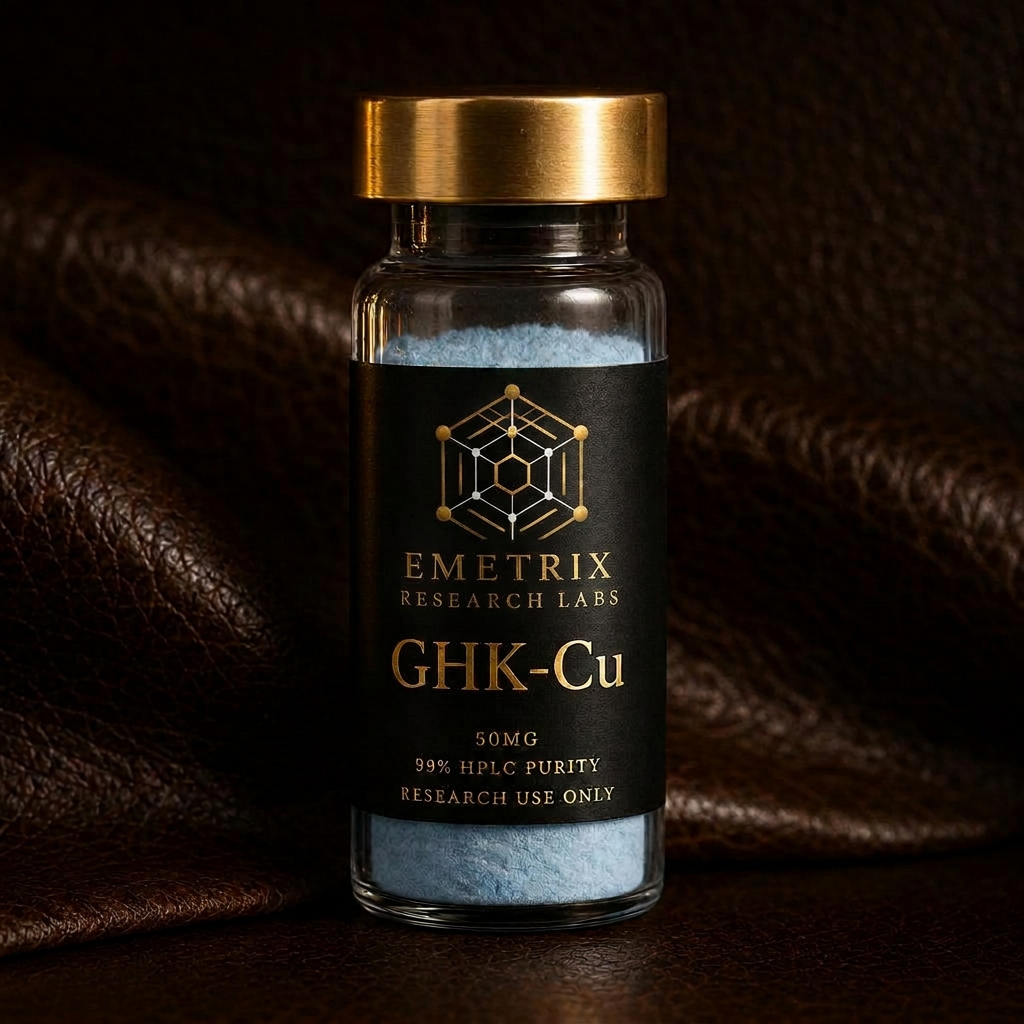
Aesthetic & Wellness Studies
GHK-Cu
Copper tripeptide — skin & extracellular matrix research.
Specifications
- Formula
- C14H24N6O4·Cu
- Molecular Weight
- 340.83 g/mol
- Storage
- Store lyophilized at -20°C
- Form
- Lyophilized powder
Description
ERM-511 is a copper-binding tripeptide investigated for its role in extracellular matrix research and tissue signalling studies.
Compound Guide
What is GHK-Cu?
Copper Peptide for Skin & Collagen
GHK-Cu is a naturally occurring copper-binding tripeptide (glycyl-L-histidyl-L-lysine) found in human plasma, with concentration falling sharply after age 20. Research focuses on its ability to deliver copper into cells and to shift gene expression toward a repair and remodeling profile.
Areas of Research Interest
Summarized from published research findings. Not medical guidance or prescribing information.
Collagen Synthesis
Studied for upregulation of collagen I and III alongside elastin and glycosaminoglycans.
Dermal Remodeling
Examined for skin firmness, texture, and fine-line endpoints in topical and subcutaneous designs.
Follicle Research
Hair-follicle size and anagen-phase duration appear as endpoints in GHK-Cu literature.
Antioxidant Signaling
Copper delivery supports superoxide dismutase activity.
Wound-Repair Models
One of the earliest studied applications, with extensive published background.
Barrier Function
Investigated for improvements in skin barrier lipid composition.
Reconstitution
- 50 mg vial + 5 mL bacteriostatic water = 10 mg/mL
- 100 mg vial + 5 mL bacteriostatic water = 20 mg/mL
- At 10 mg/mL, 10 units on a U-100 syringe = 1 mg
Suggested research protocol
- Routes studied: subcutaneous and topical formulations.
- Timing: evening, aligning with overnight dermal repair cycles.
- Cycle: 4–8 week blocks; copper accumulation makes continuous long-term use uncommon in study design.
- Refrigerate; the solution has a characteristic blue color.
Dosing Reference
| Phase | Amount | Frequency |
|---|---|---|
| Introductory | 1 mg | Daily |
| Standard | 2 mg | Daily, 4–6 weeks |
| Maintenance | 1–2 mg | 3× weekly |
Handling & Notes
- The blue tint is expected and comes from the copper complex — it is not contamination.
- Copper is cumulative; extended continuous blocks are avoided in most protocols.
- Site-localized redness is the most commonly logged observation.
Stack Up
Compounds studied alongside GHK-Cu
This guide is provided for informational and research reference only. GHK-Cu is intended for laboratory research use exclusively and is not intended to diagnose, treat, cure, or prevent any disease. Not for human or veterinary consumption.