longevity · May 14, 2026
NAD+ in Research: Cellular Energetics and Sirtuin-Pathway Endpoints
A laboratory research overview of NAD+, including mechanism, reported findings, and areas of ongoing investigator interest.

Background
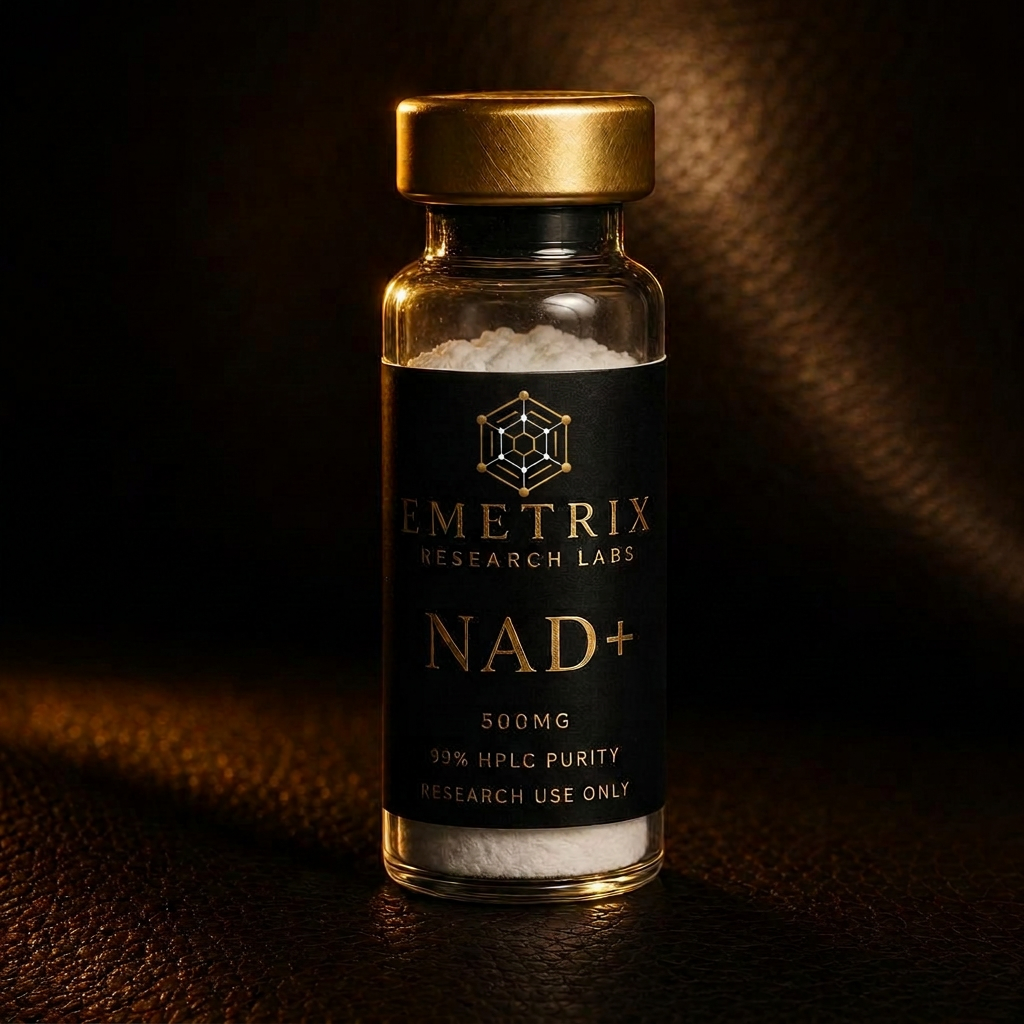
NAD+ (nicotinamide adenine dinucleotide) is a central metabolic cofactor widely used in laboratory investigations of bioenergetics, redox biology, stress responses, and cellular aging models. Although it may appear in catalogs alongside peptide and small-molecule research reagents, NAD+ is not a peptide; it is a dinucleotide composed of nicotinamide and adenine nucleotide units linked through their phosphate groups.
Interest in NAD+ has expanded as investigators have connected intracellular NAD+ availability with mitochondrial function, DNA damage responses, chromatin regulation, inflammatory signaling, and adaptive stress pathways. In preclinical models, modulation of NAD+ pools has been associated with favorable changes in cellular resilience, metabolic efficiency, and tissue-level homeostasis. These observations have made NAD+ and NAD+-related pathways a sustained focus in cell biology, aging research, neuroscience, immunometabolism, and exercise physiology.
Molecular and Structural Notes
NAD+ functions as both a redox-active coenzyme and a consumed substrate for signaling enzymes. In its oxidized form, NAD+ accepts hydride equivalents to become NADH, enabling electron transfer through glycolysis, the tricarboxylic acid cycle, beta-oxidation, and mitochondrial oxidative phosphorylation. The NAD+/NADH ratio is therefore a key indicator of cellular redox state.
Structurally, NAD+ contains an adenine nucleotide and a nicotinamide ribonucleotide joined by a pyrophosphate bridge. The nicotinamide ring is the redox-active portion, while the broader dinucleotide architecture supports enzyme recognition. In laboratory contexts, NAD+ may be evaluated directly or compared with related molecules such as NADH, NADP+, NADPH, nicotinamide riboside, nicotinamide mononucleotide, niacin, and nicotinamide. These compounds differ in uptake behavior, intracellular conversion, compartmental distribution, and enzymatic utilization.
Mechanism of Action
NAD+ participates in two broad mechanistic categories: reversible redox chemistry and irreversible enzymatic consumption.
In redox metabolism, NAD+ accepts electrons during catabolic reactions and supports ATP generation through mitochondrial respiration. A maintained NAD+/NADH balance is important for metabolic flux, lactate-pyruvate equilibrium, fatty acid oxidation, and mitochondrial membrane potential.
In signaling biology, NAD+ is consumed by several enzyme families. Sirtuins use NAD+ as a substrate for deacylation reactions that influence mitochondrial biogenesis, stress adaptation, antioxidant defense, and transcriptional regulation. PARP enzymes use NAD+ during poly-ADP-ribosylation processes involved in DNA repair and genomic stability. CD38 and related ectoenzymes metabolize NAD+ into signaling metabolites that can influence calcium mobilization and immune-cell behavior. SARM1, an NADase implicated in axonal degeneration models, has also become a notable target in neurobiology research.
Because these pathways compete for NAD+, changes in NAD+ abundance may affect multiple systems simultaneously. This pleiotropy is one reason NAD+ biology attracts broad investigator interest, while also requiring careful experimental design.
Reported Research Findings
Across cell-based and animal studies, higher NAD+ availability or improved NAD+ salvage pathway activity has been associated with several positive preclinical findings. In metabolic models, NAD+-supportive interventions are often linked with improved mitochondrial respiration, enhanced oxidative metabolism, and more favorable markers of insulin sensitivity and lipid handling. Skeletal muscle studies frequently report improved endurance-related signaling, mitochondrial gene expression, and resistance to metabolic stress.
In aging-related research, NAD+ levels are commonly observed to decline in multiple tissues under conditions of chronological aging, inflammatory stress, or genotoxic burden. Restoration of NAD+-linked pathways in preclinical systems has been associated with improved cellular repair capacity, enhanced proteostasis markers, and better maintenance of stem or progenitor cell function in selected models.
Neuroscience investigations have reported interest in NAD+ for models of axonal integrity, mitochondrial stress, excitotoxicity, and neuroinflammation. In these contexts, NAD+-related pathways are studied for their potential to support neuronal energy metabolism and stress tolerance. Cardiometabolic and renal research groups have similarly examined NAD+ biology in ischemia-reperfusion, oxidative injury, and tissue remodeling models, with generally encouraging mechanistic signals.
Immunology studies have highlighted NAD+ metabolism as a regulator of immune-cell activation, macrophage polarization, inflammatory cytokine patterns, and tissue repair responses. These findings have broadened the field beyond classic energy metabolism and positioned NAD+ as a central node in immunometabolic regulation.
Areas of Ongoing Investigation
Current research continues to examine how NAD+ pools are regulated across subcellular compartments, including cytosol, mitochondria, and nucleus. Investigators are especially interested in whether total cellular NAD+ measurements fully capture biologically relevant changes, or whether compartment-specific dynamics better explain experimental outcomes.
Another active area concerns the comparative utility of NAD+ itself versus precursors and salvage pathway modulators. Since cellular uptake, extracellular metabolism, and conversion efficiency can vary by model system, researchers often evaluate multiple NAD+-related compounds side by side. Questions remain about tissue specificity, dose-response behavior, timing, and long-term pathway adaptation.
Disease-model research is also expanding. Investigators are exploring NAD+ metabolism in neurodegeneration, metabolic syndrome, muscle wasting, inflammatory disorders, reproductive aging, liver injury, cardiovascular stress, and recovery from genotoxic challenge. Parallel work is focused on enzymes that consume NAD+, including CD38 inhibition, PARP regulation, and SARM1 modulation, with the aim of preserving NAD+ pools or directing them toward beneficial cellular programs.
Handling and Stability Considerations
For laboratory use, NAD+ is typically handled as a hygroscopic powder or lyophilized solid. It should be stored tightly sealed, protected from moisture, heat, and strong light. Low-temperature storage, commonly at -20°C or below, is generally preferred for long-term preservation. Repeated freeze-thaw cycles should be minimized by preparing small aliquots.
NAD+ is readily soluble in aqueous buffers, but fresh preparation is recommended for sensitive assays. Stability can be influenced by pH, temperature, enzymatic contamination, and storage duration. Strongly acidic or alkaline conditions may promote degradation, and prolonged incubation at elevated temperature should be avoided unless experimentally required. For cell-culture applications, investigators commonly use sterile technique, appropriate filtration where compatible, and endotoxin-controlled materials when immune or inflammatory readouts are involved.
Analytical confirmation may include UV absorbance, HPLC, LC-MS, or enzyme-coupled assays, depending on the study objective. Because NAD+, NADH, and related metabolites can interconvert or degrade during extraction, sample handling protocols should be standardized and validated for each matrix.
Outlook
NAD+ remains a high-interest research reagent because it connects core metabolism with genome maintenance, mitochondrial biology, inflammatory regulation, and cellular stress adaptation. Preclinical findings continue to support its value as a tool for probing resilience pathways and age-associated biological change. As assay technologies improve, especially for compartmental and real-time NAD+ measurements, investigators are likely to gain a more precise understanding of when and how NAD+ modulation produces favorable experimental outcomes.
content is for laboratory research purposes only, not for human use.
Related products