
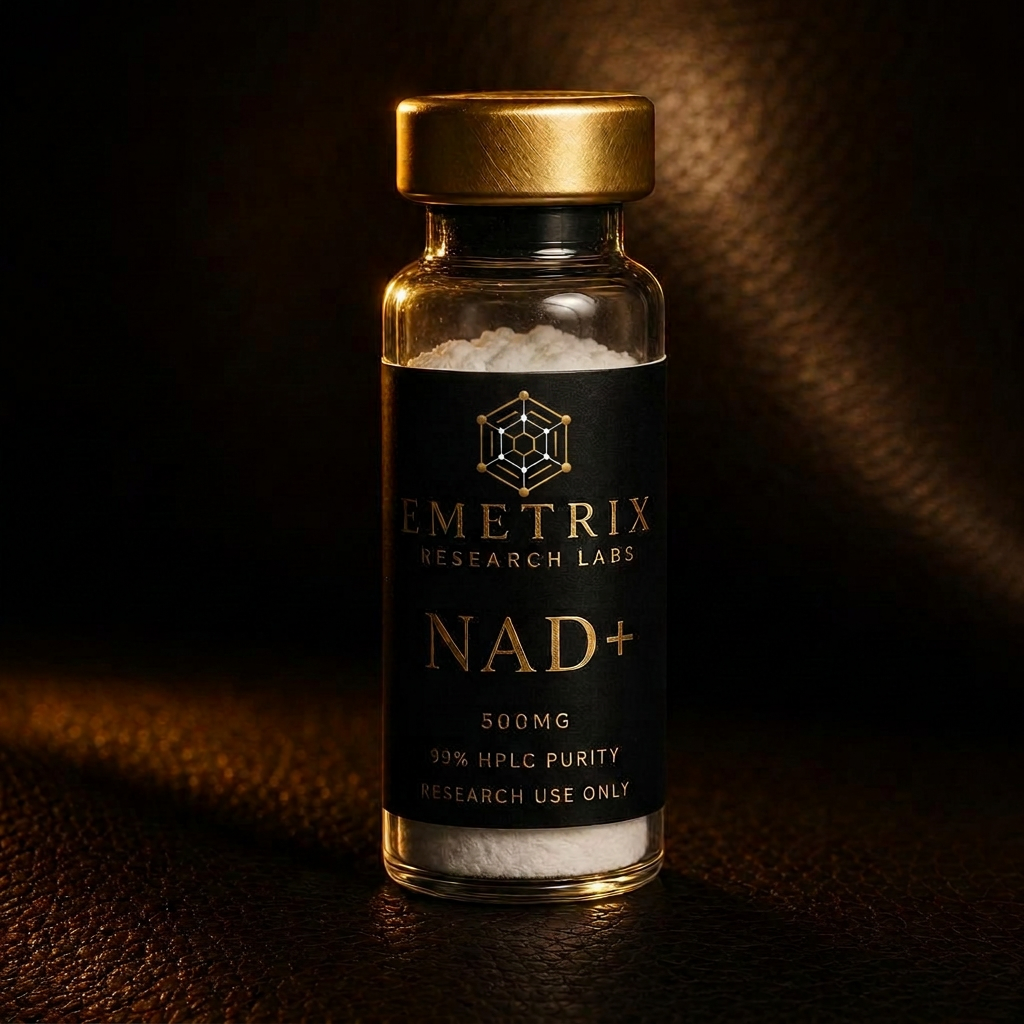
Metabolic Studies
NAD+
Nicotinamide adenine dinucleotide — cellular metabolism research.
Specifications
- Formula
- C21H27N7O14P2
- Molecular Weight
- 663.43 g/mol
- Storage
- Store lyophilized at -20°C
- Form
- Lyophilized powder
Description
ERM-828 is a research-grade NAD+ compound studied in mitochondrial function, sirtuin activity, and cellular energy pathways.
Compound Guide
What is NAD+?
Cellular Energy & Longevity Signaling
Nicotinamide adenine dinucleotide is a coenzyme present in every living cell, central to mitochondrial electron transport and to sirtuin and PARP enzyme activity. Tissue NAD+ concentration declines measurably with age, making direct repletion one of the most studied approaches in longevity research.
Areas of Research Interest
Summarized from published research findings. Not medical guidance or prescribing information.
Mitochondrial Output
Direct substrate for the electron transport chain and cellular ATP production.
Sirtuin Activation
NAD+ is the required cofactor for SIRT1–SIRT7, the enzymes central to longevity research.
Cognitive Endpoints
Neuronal energy availability and clarity measures appear across NAD+ literature.
DNA Repair
PARP enzymes consume NAD+ during DNA-damage response; repletion supports that capacity.
Metabolic Rate
Studied for substrate-utilization efficiency at the cellular level.
Circadian Signaling
NAD+ oscillates on a daily rhythm and interacts with clock-gene expression.
Reconstitution
- 100 mg vial + 2 mL bacteriostatic water = 50 mg/mL
- 500 mg vial + 5 mL bacteriostatic water = 100 mg/mL
- At 50 mg/mL, 10 units on a U-100 syringe = 5 mg
Suggested research protocol
- Route studied: subcutaneous; slow administration is standard.
- Timing: morning, as evening administration is associated with alertness in logs.
- Cycle: 2–4 week blocks with escalating amounts, followed by a maintenance interval.
- Refrigerate and protect from light.
Dosing Reference
| Phase | Amount | Frequency |
|---|---|---|
| Introductory | 10–25 mg | Daily |
| Standard | 50 mg | Daily |
| Maintenance | 50–100 mg | 2–3× weekly |
Handling & Notes
- Rapid administration is consistently associated with transient flushing — slow delivery is the standard control.
- Begin at the low end of the range; NAD+ tolerance is highly individual in the literature.
- Solution may develop color with light exposure; store in the dark.
Stack Up
Compounds studied alongside NAD+
This guide is provided for informational and research reference only. NAD+ is intended for laboratory research use exclusively and is not intended to diagnose, treat, cure, or prevent any disease. Not for human or veterinary consumption.