regenerative · May 15, 2026
GHK-Cu in Preclinical Skin Regeneration Research
GHK-Cu is a naturally occurring copper-binding tripeptide studied for matrix remodeling, wound-associated signaling, and cellular responses relevant to skin repair. Laboratory findings suggest activity across fibroblast behavior, collagen regulation, inflammation-associated pathways, and oxidative stress models.
Research context
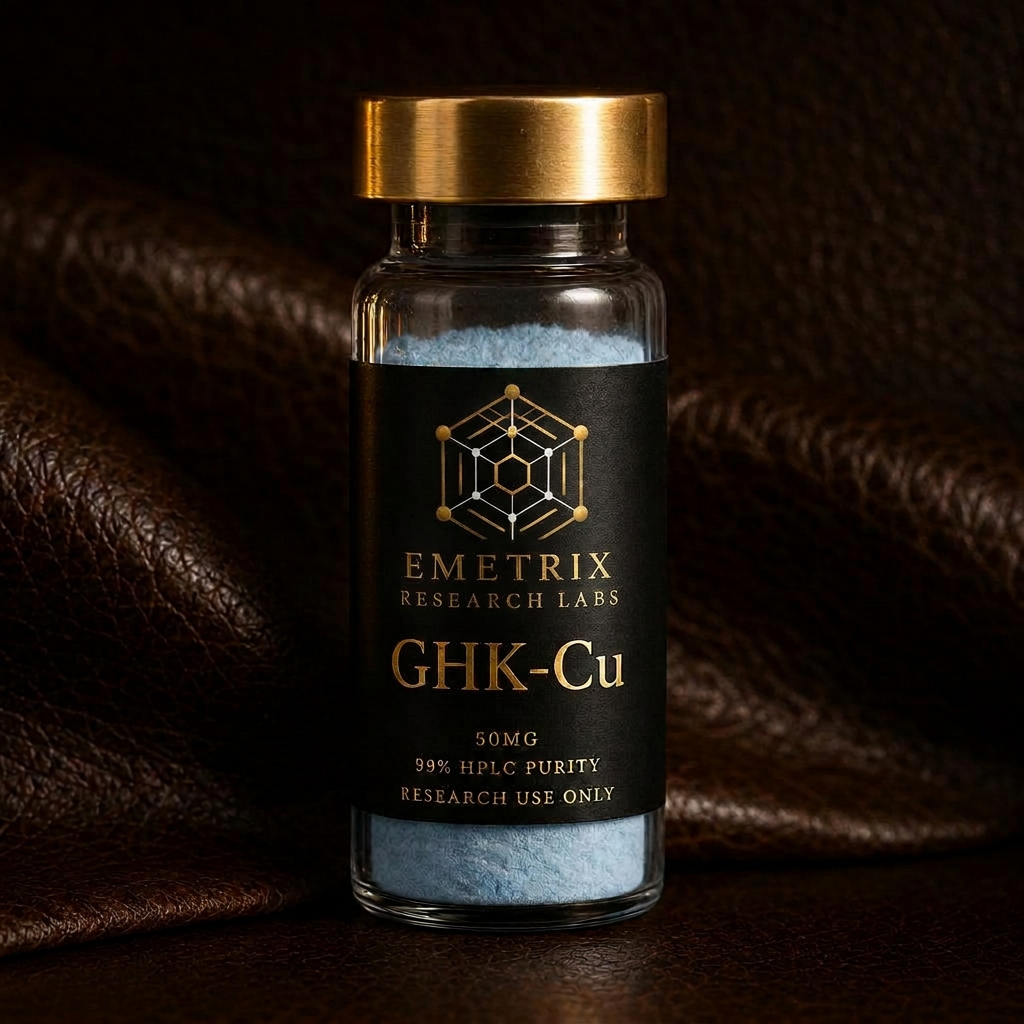
Glycyl-L-histidyl-L-lysine copper complex, commonly abbreviated GHK-Cu, is a small copper-binding tripeptide investigated in skin biology and regenerative research. The peptide was originally identified in human plasma and has since been examined in cell culture, ex vivo skin systems, and animal wound models. Its relevance to regenerative skin research arises from two related properties: the peptide sequence can coordinate copper ions, and copper is a required cofactor for enzymes involved in extracellular matrix maturation and tissue repair-associated processes.
In the laboratory literature, GHK-Cu is usually discussed as a signaling-associated peptide rather than simply a mineral delivery vehicle. Investigators have reported changes in gene expression, matrix protein turnover, inflammatory mediators, and oxidative stress responses after exposure to the copper complex. These observations are preclinical and mechanistic; they do not establish clinical efficacy or support human use recommendations. They do, however, provide a useful framework for studying how copper-peptide complexes may influence skin-relevant repair programs in controlled research models.
Molecular characteristics and copper coordination
GHK is a tripeptide composed of glycine, histidine, and lysine. The histidine residue is central to copper coordination, while the N-terminal and neighboring residues contribute to a stable complex with Cu(II). This coordination chemistry distinguishes GHK-Cu from unbound copper salts, which can participate in redox reactions and may produce nonspecific cytotoxicity at inappropriate concentrations in vitro.
In experimental design, this distinction is important. Researchers typically evaluate GHK-Cu as a defined complex and compare it with vehicle controls, free peptide, or copper-containing controls. Such comparisons help separate peptide-dependent signaling from nonspecific copper effects. Because copper availability can alter assay outcomes, media composition, serum content, chelators, and trace metal contamination are relevant variables. Skin cell culture systems, particularly fibroblast and keratinocyte models, may respond differently depending on proliferative state, baseline oxidative stress, and matrix attachment conditions.
The regenerative interest in GHK-Cu is partly linked to copper-dependent enzymes such as lysyl oxidase, which participates in collagen and elastin cross-linking. However, not all observed effects can be reduced to copper cofactor biology. Several transcriptomic and targeted molecular studies suggest that GHK-Cu exposure can influence broader repair-associated pathways, including extracellular matrix organization, protease balance, and inflammatory signaling.
Fibroblast and extracellular matrix findings
Dermal fibroblasts are a central model for studying GHK-Cu because they regulate collagen deposition, matrix remodeling, and wound-associated stromal responses. In preclinical studies, investigators have observed that GHK-Cu can modulate fibroblast proliferation, migration, and matrix production under selected culture conditions. Reported endpoints include increased expression or deposition of collagen-related proteins, altered glycosaminoglycan synthesis, and changes in extracellular matrix organization.
Matrix remodeling is not solely a question of increasing collagen. Regenerative repair requires coordinated synthesis and degradation. Several studies have examined matrix metalloproteinases, tissue inhibitors of metalloproteinases, and protease-associated remodeling after GHK-Cu exposure. Some reports suggest that the peptide complex may help normalize matrix turnover in damaged or stress-exposed models, although the direction and magnitude of effects depend on the system used. This variability is expected in skin research, where fibroblast phenotype differs by donor source, anatomical site, passage number, and inflammatory context.
GHK-Cu has also been studied in relation to decorin, elastin-associated components, and other matrix-regulatory molecules. These endpoints are relevant because regenerated skin architecture depends on more than collagen abundance. Proper fibril organization, elastic fiber integrity, and proteoglycan distribution influence tissue mechanics in ex vivo and animal models. At present, the strongest interpretation is that GHK-Cu can alter matrix-associated cellular programs in vitro and in preclinical settings; whether these changes translate into durable tissue-level regeneration remains model-dependent.
Keratinocyte, wound model, and epithelial responses
Although fibroblasts receive substantial attention, keratinocytes are also important in GHK-Cu research. Re-epithelialization in wound models requires keratinocyte migration, proliferation, and barrier-associated differentiation. Laboratory studies have examined whether GHK-Cu affects keratinocyte behavior directly or indirectly through fibroblast-conditioned media and matrix changes.
In scratch assays and related migration models, investigators have reported enhanced closure rates under some GHK-Cu conditions. These assays are useful but limited. Scratch closure can reflect proliferation, migration, altered adhesion, or changes in cell survival. For that reason, more informative designs pair live-cell imaging with proliferation markers, cytotoxicity assays, and matrix controls. Three-dimensional skin equivalents and ex vivo explants provide additional context by preserving epithelial-stromal interactions, although they introduce variability in diffusion, peptide stability, and tissue baseline condition.
Animal wound models have been used to study GHK-Cu-containing formulations or delivery systems, with reported changes in wound contraction, granulation tissue, collagen organization, and inflammatory cell profiles. Such findings remain preclinical and should be interpreted with attention to species differences, wound type, occlusion, vehicle composition, and sampling time. Rodent skin heals with a greater contractile component than human skin, which can confound regeneration-oriented interpretation. Porcine and ex vivo human skin models may offer closer structural relevance for some questions, but each has its own methodological constraints.
Inflammation and oxidative stress pathways
Regenerative skin repair requires resolution of inflammatory signaling without suppressing necessary early defense and cleanup processes. GHK-Cu has been evaluated in models involving cytokine exposure, ultraviolet-associated stress, and reactive oxygen species. Investigators have observed changes in markers such as interleukin signaling, transforming growth factor beta-associated pathways, nuclear factor kappa B-related activity, and antioxidant enzyme expression, depending on the experimental system.
Copper biology makes oxidative stress interpretation particularly nuanced. Free copper can catalyze redox cycling under some conditions, while copper-dependent enzymes such as superoxide dismutase participate in antioxidant defense. A coordinated copper-peptide complex may behave differently from free ionic copper. Therefore, assays should include appropriate controls for copper source, peptide alone, and cell viability. Measurements based only on bulk reactive oxygen species fluorescence can be misleading unless paired with mitochondrial function, lipid peroxidation, protein oxidation, or antioxidant response markers.
The inflammation literature also supports caution. Reduced inflammatory marker expression in a simplified cell model does not necessarily indicate improved regenerative outcome in tissue. In vivo repair requires a sequence of inflammatory, proliferative, and remodeling phases. A compound that shifts one marker at one time point may have different effects across the repair timeline. Time-course studies are particularly important for GHK-Cu because matrix synthesis, protease activity, and cytokine responses may peak at different intervals.
Experimental considerations for skin research
For laboratories evaluating GHK-Cu, reagent characterization is a primary concern. The copper coordination state, purity, counterions, solvent system, pH, and storage conditions can affect reproducibility. Peptides may adsorb to plasticware or degrade under repeated freeze-thaw cycles. Copper may interact with media proteins or chelating agents. Reporting these parameters improves comparability across studies.
Dose-response design in vitro should emphasize concentration ranges that preserve viability and avoid nonspecific metal toxicity. Because this article concerns laboratory research only, these concentrations should not be extrapolated to human use. Cell type selection also matters. Primary dermal fibroblasts, keratinocytes, endothelial cells, macrophage-like cells, and co-culture systems each capture different aspects of regenerative biology. Senescent, UV-stressed, diabetic-mimetic, or oxidative stress models may reveal distinct responses compared with unstressed cultures.
Endpoints should extend beyond single biomarkers. A robust GHK-Cu skin research study might combine transcript analysis, secreted protein quantification, matrix imaging, migration assays, mechanical assessment in engineered tissues, and histology in ex vivo models. Including both early signaling time points and later matrix remodeling readouts helps distinguish transient pathway activation from structural outcomes.
Current interpretation
The preclinical record supports GHK-Cu as a useful probe in regenerative skin research, particularly for studying copper-peptide interactions with fibroblast activity, extracellular matrix remodeling, epithelial behavior, inflammation-associated pathways, and oxidative stress responses. The most consistent theme is not a single isolated mechanism, but a network of modest, context-dependent effects relevant to repair biology.
Key uncertainties remain. The relative contribution of copper delivery versus peptide-specific signaling is not fully resolved. Model systems differ substantially in baseline copper status, cellular age, inflammatory state, and matrix environment. Delivery variables can also shape results, especially in tissue and wound models where diffusion and binding influence local exposure.
For these reasons, GHK-Cu should be viewed as a mechanistically interesting research compound rather than a settled regenerative intervention. Continued work in well-characterized skin equivalents, ex vivo tissue, and carefully controlled animal models may clarify where its effects are reproducible, which pathways are primary, and how copper coordination contributes to skin repair-associated biology.
Related products