regenerative · April 30, 2026
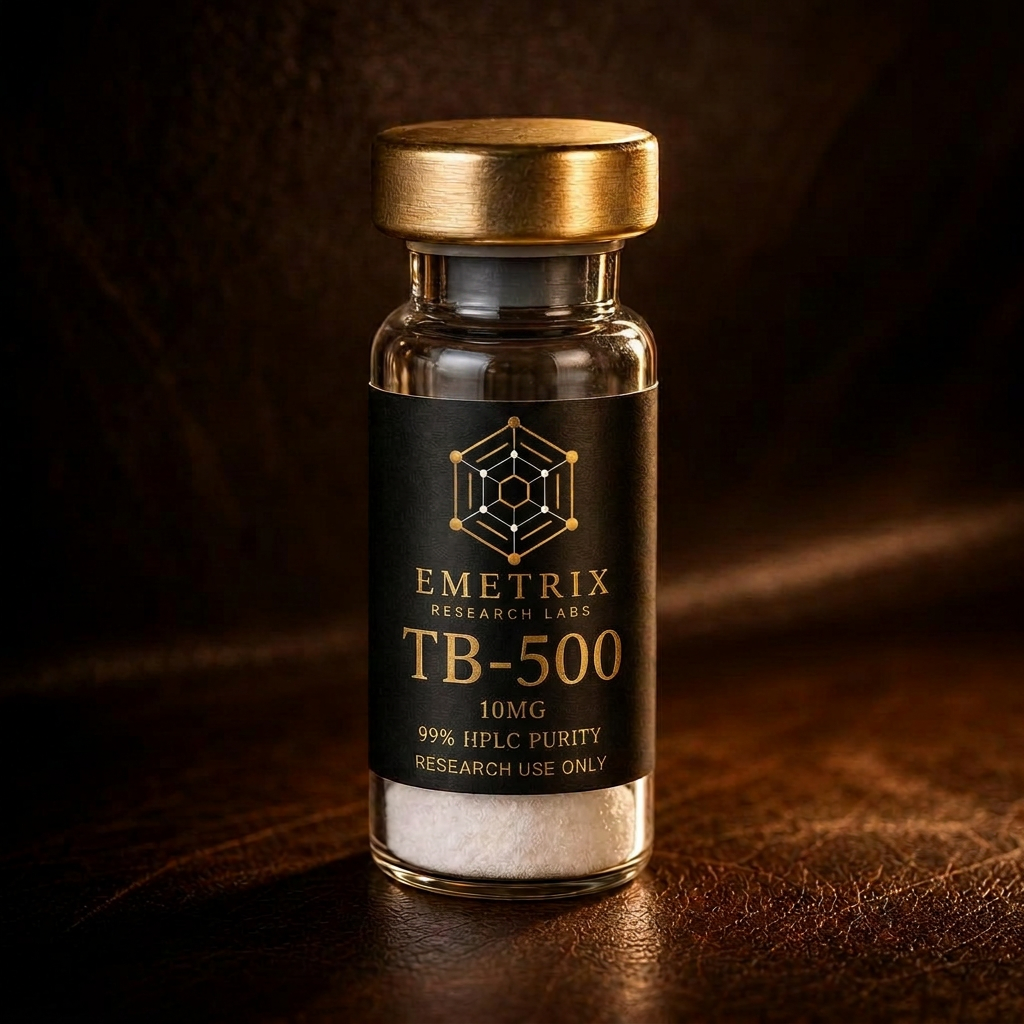
TB-500 (Thymosin Beta-4 Fragment): Actin-Binding Peptide Research Overview
A laboratory research overview of TB-500, including mechanism, reported findings, and areas of ongoing investigator interest.

Background
TB-500 is a synthetic peptide widely discussed in laboratory research contexts for its relationship to thymosin beta-4, a naturally occurring, highly conserved peptide found in many mammalian tissues. Thymosin beta-4 has attracted sustained interest because of its association with cytoskeletal regulation, tissue remodeling, cellular migration, angiogenic signaling, and repair-oriented biological responses in preclinical systems. TB-500 is generally described as a research peptide modeled on a functional region of thymosin beta-4, with interest centered on whether shorter synthetic fragments can reproduce selected biological activities observed with the native molecule.
In research supply and discovery settings, TB-500 is most often positioned as a tool compound for studying cellular motility, actin dynamics, and tissue-response pathways. Investigators have examined thymosin beta-4-related peptides in models involving soft tissue injury, musculoskeletal stress, epithelial repair, inflammatory modulation, and vascular remodeling. While the research literature remains primarily preclinical, the breadth of experimental interest reflects the peptide’s relevance to fundamental questions in regeneration biology and wound-response signaling.
Molecular and Structural Notes
Thymosin beta-4 is a small acidic peptide of 43 amino acids. Its best-known biochemical feature is interaction with G-actin, the monomeric form of actin, which is essential for cytoskeletal organization and cell movement. TB-500 is commonly discussed as a synthetic peptide fragment or analog related to this functional domain, although product identity and sequence can vary by supplier and research context. For this reason, careful attention to certificate of analysis documentation, purity data, and sequence confirmation is important when designing experiments.
From a structural standpoint, peptides in this class are flexible rather than rigidly folded. Their biological relevance is often tied less to a stable three-dimensional structure and more to transient interactions with intracellular or extracellular binding partners. This flexibility may help explain why thymosin beta-4-related sequences are studied across diverse model systems, including fibroblasts, endothelial cells, keratinocytes, immune-associated cells, and muscle or connective tissue-derived preparations.
Mechanism of Action
The central mechanistic theme associated with thymosin beta-4 and TB-500-related research is regulation of actin dynamics. By binding actin monomers or influencing actin availability, thymosin beta-4 can affect cytoskeletal rearrangement, a process required for cell migration, spreading, and structural adaptation. These events are particularly relevant in tissue repair models, where cells must move into damaged regions, remodel extracellular matrix, and coordinate new tissue formation.
Beyond actin regulation, preclinical work has associated thymosin beta-4-related peptides with angiogenesis-linked pathways. Endothelial cell migration and tube formation are common experimental readouts in this area. Additional mechanistic themes include modulation of inflammatory signaling, effects on oxidative stress responses, and changes in expression of proteins involved in extracellular matrix remodeling. Investigators have also examined interactions with survival pathways that may support cell resilience under stress conditions.
It is important to note that these mechanisms are interdependent. Enhanced migration, reduced inflammatory burden, and vascular remodeling may appear as separate outcomes in an assay, but they often converge during tissue repair. TB-500 is therefore commonly studied not as a single-target ligand in the classical pharmacological sense, but as a peptide tool associated with broader repair-associated cellular programs.
Reported Research Findings
Preclinical research involving thymosin beta-4-related peptides has produced several positive findings that continue to motivate investigator interest. In wound-healing models, researchers have reported improved cellular migration, faster closure of experimental scratch assays, and enhanced epithelial or dermal repair markers. These effects are often interpreted through the lens of cytoskeletal remodeling and coordinated movement of repair-associated cells.
In musculoskeletal and connective tissue models, research interest has focused on tendon, ligament, skeletal muscle, and cartilage-associated responses. Experimental systems have explored whether thymosin beta-4-related peptides may support matrix organization, reduce maladaptive inflammatory signals, or improve histological features associated with repair. While outcomes vary depending on model design, the recurring observation is that peptide exposure can influence cellular behaviors relevant to remodeling and recovery.
Angiogenesis is another prominent area of reported activity. Endothelial cell studies have noted pro-migratory and vessel-formation-associated effects under certain experimental conditions. In tissue repair, vascular ingrowth is a key component of nutrient delivery and structural restoration, making angiogenic signaling a logical area of interest for researchers studying TB-500-related materials.
Additional preclinical themes include cardioprotective and neuroprotective models, where thymosin beta-4-related signaling has been examined in the context of cell survival, inflammatory balance, and tissue remodeling after injury-like stress. These findings remain exploratory, but they have broadened the scientific conversation beyond simple wound closure toward more complex questions of organ repair and regeneration.
Areas of Ongoing Investigation
Current investigator interest in TB-500 and related peptides is shaped by several unresolved questions. One major area is structure-activity relationship research. Because TB-500 is typically associated with a selected functional portion of thymosin beta-4, laboratories are interested in identifying which sequence elements are required for actin interaction, cellular uptake, migration effects, or downstream signaling changes.
Another area of active inquiry is context specificity. Peptide effects may differ substantially across cell types, injury models, dosing schedules, and assay environments. A concentration that promotes migration in one cellular system may produce weaker or different effects in another. For this reason, researchers often pair functional assays with molecular readouts such as gene expression, protein phosphorylation, matrix-marker analysis, and inflammatory mediator profiling.
Delivery and stability are also important research topics. Peptides may be susceptible to enzymatic degradation, adsorption to surfaces, or loss of activity under suboptimal storage conditions. Experimental reproducibility depends on defining reconstitution protocols, working concentrations, exposure times, and appropriate controls. Investigators are also interested in comparing native thymosin beta-4, shorter fragments, and modified analogs to better understand how peptide length and chemical composition influence biological activity.
Handling and Stability Considerations
As with most research peptides, TB-500 should be handled using standard laboratory practices that minimize contamination, moisture exposure, and repeated freeze-thaw cycles. Lyophilized material is typically stored cold and protected from light and humidity until use. Once reconstituted, aliquoting into single-use volumes can help preserve consistency across experiments.
Solvent choice should be guided by supplier documentation and experimental compatibility. Sterile water, buffered aqueous solutions, or other laboratory-appropriate solvents may be used depending on peptide properties and downstream assays. Researchers should confirm solubility visually and analytically where possible, especially for quantitative studies.
Analytical characterization is recommended for critical applications. Common documentation may include purity by HPLC, mass confirmation by mass spectrometry, appearance, net peptide content, and batch-specific storage recommendations. Because small differences in peptide identity, purity, or counterion composition can affect assay performance, lot traceability is valuable for longitudinal studies.
Outlook
TB-500 remains a peptide of notable interest in preclinical research because it sits at the intersection of cytoskeletal biology, tissue repair, angiogenic signaling, and inflammatory modulation. Positive findings in cell culture and animal-model systems have encouraged continued investigation into its relationship with thymosin beta-4 biology and its potential utility as a research tool for studying regeneration-associated pathways.
Future progress will depend on careful experimental design, rigorous peptide characterization, and clearer differentiation between effects attributable to native thymosin beta-4 and those associated with shorter synthetic sequences. As investigators refine models and analytical methods, TB-500-related research may continue to illuminate how actin regulation and repair signaling are coordinated during biological recovery processes.
Content is for laboratory research purposes only, not for human use.
Related products