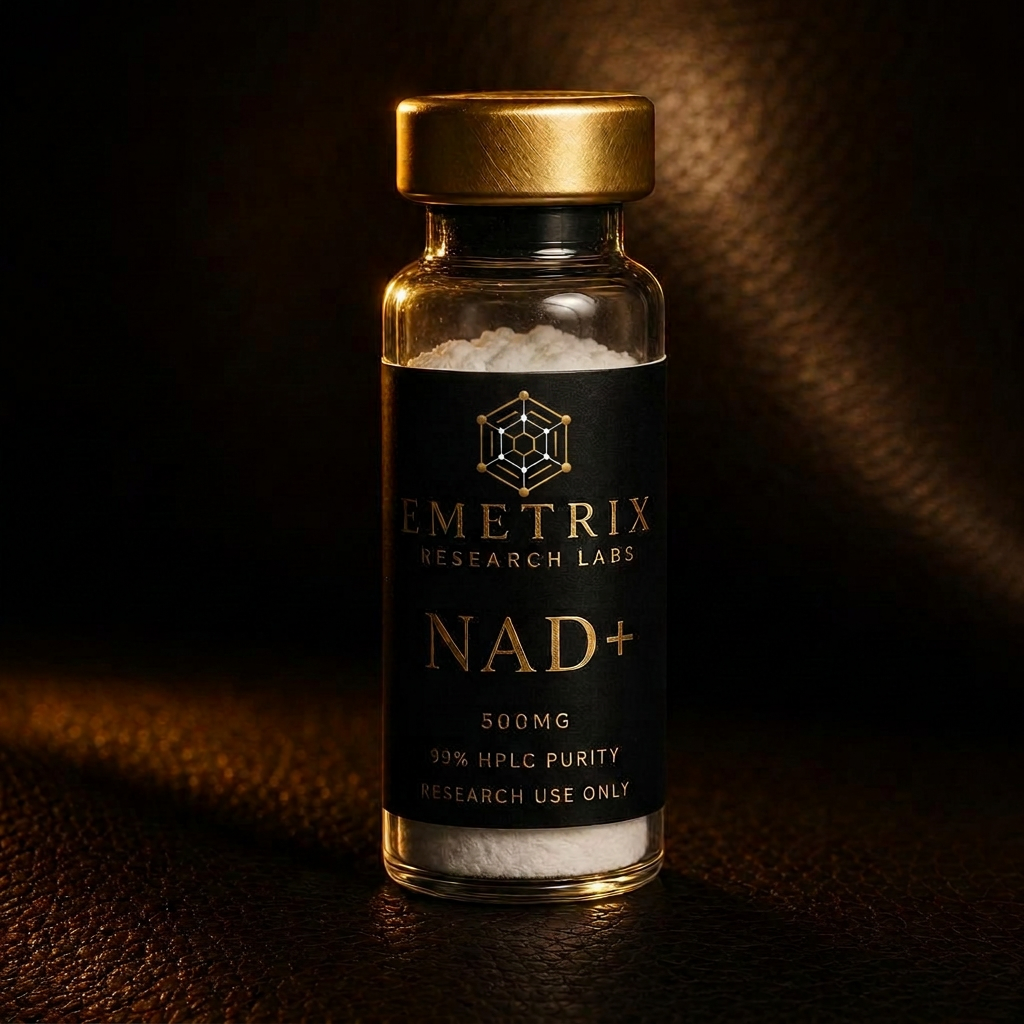
longevity · August 17, 2026
NAD+ and Its Precursors: Redox Cofactor Research in Aging Models
NAD+ availability governs sirtuin and PARP activity. An overview of precursor pharmacology, tissue distribution questions, and model limitations.

Background: The Role of Nicotinamide Adenine Dinucleotide in Cellular Energetics
Nicotinamide adenine dinucleotide (NAD+) serves as an essential pyridine nucleotide coenzyme involved in fundamental cellular metabolic processes. Operating in a continuous balance between its oxidized (NAD+) and reduced (NADH) forms, the molecule mediates hydride transfer reactions necessary for glycolysis, the tricarboxylic acid (TCA) cycle, and mitochondrial oxidative phosphorylation. Beyond its classic role in redox biochemistry, NAD+ functions as a required co-substrate for non-redox enzymes involved in genomic maintenance, post-translational modifications, and cellular signaling networks.
Extensive research across diverse animal model organisms—including Caenorhabditis elegans, Drosophila melanogaster, and Mus musculus—has documented a progressive decline in intracellular NAD+ concentration during chronological aging. This depletion correlates with reduced metabolic efficiency, compromised DNA repair capacity, and altered chromatin structure. Consequently, the mechanisms governing NAD+ biosynthesis, degradation pathways, and precursor supplementation protocols represent major subjects of investigation within experimental biogerontology.
Biochemical Mechanisms and Precursor Pathways
Biosynthetic Pathways and Precursor Dynamics
Mammalian cells synthesize NAD+ through three distinct metabolic routes: the de novo pathway from L-tryptophan, the Preiss-Handler pathway from nicotinic acid (NA), and the salvage pathway from nicotinamide (NAM). Among these, the salvage pathway predominates in maintaining intracellular NAD+ pools under homeostatic conditions. Within this pathway, nicotinamide phosphoribosyltransferase (NAMPT) acts as the rate-limiting enzyme, converting NAM into nicotinamide mononucleotide (NMN), which is subsequently converted into NAD+ by nicotinamide mononucleotide adenylyltransferases (NMNATs).
Nicotinamide riboside (NR) serves as an alternative intermediate, entering the salvage pathway via phosphorylation by nicotinamide riboside kinases (NRK1 and NRK2). In laboratory setups, extracellular NR and NMN are utilized to bypass rate-limiting controls such as NAMPT downregulation, thereby elevating intracellular NAD+ pools.
Substrate Utilization by Consuming Enzymes
The cellular NAD+ pool is continuously depleted by three major classes of consuming enzymes:
- Sirtuins (SIRT1–SIRT7): Class III histone deacetylases that require NAD+ to cleave acetyl groups from lysine residues on histones and non-histone proteins (such as PGC-1α, FOXO3a, and p53), thereby regulating gene expression, mitochondrial biogenesis, and stress response cascades.
- Poly(ADP-ribose) Polymerases (PARPs): Enzymes involved in single-strand DNA break repair that consume NAD+ to synthesize ADP-ribose polymers onto target nuclear proteins. Chronic activation of PARP1 due to accumulated genomic stress depletes the cytosolic and nuclear NAD+ reservoirs.
- CD38/CD157 Glycohydrolases: Ecto-enzymes responsible for degrading NAD+ to generate cyclic ADP-ribose and nicotinamide. Age-dependent upregulation of CD38 in immune cells and vascular tissue is considered a primary driver of systemic NAD+ decline in aged rodent paradigms.
Phenotypic Observations in Preclinical Aging Models
Preclinical investigations utilizing rodents, invertebrate strains, and cell culture lines demonstrate that supporting intracellular NAD+ levels via precursor administration yields distinct physiological shifts across several tissue systems.
Mitochondrial Homeostasis and Energetics
Administration of precursors such as NMN or NR in aged murine models has been reported to restore mitochondrial respiratory chain efficiency, elevate the oxygen consumption rate (OCR), and enhance mitochondrial DNA copy number. These changes are frequently attributed to SIRT1-mediated activation of peroxisome proliferator-activated receptor gamma coactivator 1-alpha (PGC-1α), which drives mitochondrial biogenesis and structural maintenance.
Metabolic and Vascular Parameters
In rodent models of metabolic dysfunction induced by diet or advanced age, precursor supplementation demonstrates improvements in hepatic insulin sensitivity, reduced lipid accumulation in parenchymal tissues, and preserved glucose tolerance. Furthermore, elevated NAD+ availability supports endothelial SIRT1 activity, which maintains endothelial nitric oxide synthase (eNOS) function and enhances capillary density in skeletal muscle tissue, thereby mitigating age-related exercise capacity decline in experimental groups.
Genomic Maintenance and Senescence
Supporting the nuclear NAD+ pool allows for sustained PARP enzymatic function during genotoxic stress without driving cellular energy collapse. Additionally, research models indicate that controlling NAD+ turnover modulates the senescence-associated secretory phenotype (SASP), although the precise balance between supporting cellular clearance and driving pro-inflammatory output remains under active investigation.
Methodological Considerations and Analytical Challenges
Investigating NAD+ biology requires strict analytical controls due to the rapid enzymatic and non-enzymatic degradation of pyridine nucleotides during tissue harvest. Validated protocols utilize liquid chromatography-tandem mass spectrometry (LC-MS/MS) coupled with rapid acid-quenching techniques to isolate NAD+, NADH, NMN, and NR without artifactual oxidation or degradation.
Furthermore, precursor transport dynamics vary significantly across tissue types. Debate remains regarding the direct transport of NMN via specific membrane transporters (such as Slc12a8) versus its extracellular dephosphorylation to NR prior to cellular entry. Additionally, elevating NAD+ availability in models with pre-existing neoplastic transformations presents an analytical concern, as elevated NAD+ flux can support the heightened glycolytic and respiratory demands of malignant cells.
Mandatory Compliance and Research-Use-Only Status
All compounds discussed—including NAD+, NMN, NR, and related metabolic intermediates—are strictly intended for laboratory research and development applications. They are classified as Research Use Only (RUO) and are not intended for human or animal consumption, diagnostic procedures, clinical trials, or therapeutic use. Experimental setups must conform to established institutional chemical safety protocols and regulatory guidelines.
Related products