growth · August 6, 2026
CJC-1295: Sustained GHRH Analog Signaling in Endocrine Research
How CJC-1295's extended half-life shapes growth hormone pulse studies, and what preclinical literature reports about its secretagogue profile.

Background and Structural Modifications
Growth Hormone-Releasing Hormone (GHRH) is a primary hypothalamic peptide responsible for orchestrating the synthesis and secretion of growth hormone (GH) from the anterior pituitary gland. Native GHRH, as well as its truncated fully functional sequence, GHRH(1-29)amide (sermorelin), exhibits a brief plasma half-life—typically under twelve minutes in mammalian subjects. Rapid inactivation occurs predominantly via cleavage by endopeptidases, specifically dipeptidyl peptidase IV (DPP-IV), which cleaves the peptide between the second (Ala) and third (Asp) N-terminal amino acid residues.
To overcome these kinetic limitations in laboratory investigations of somatotropic signaling, synthetic peptide chemistry yielded CJC-1295. CJC-1295 is a tetrasubstituted 29-amino acid peptide analog of GHRH. The sequence incorporates specific amino acid substitutions designed to resist enzymatic degradation: D-Alanine at position 2, Glutamine at position 8, Alanine at position 15, and Leucine at position 27.
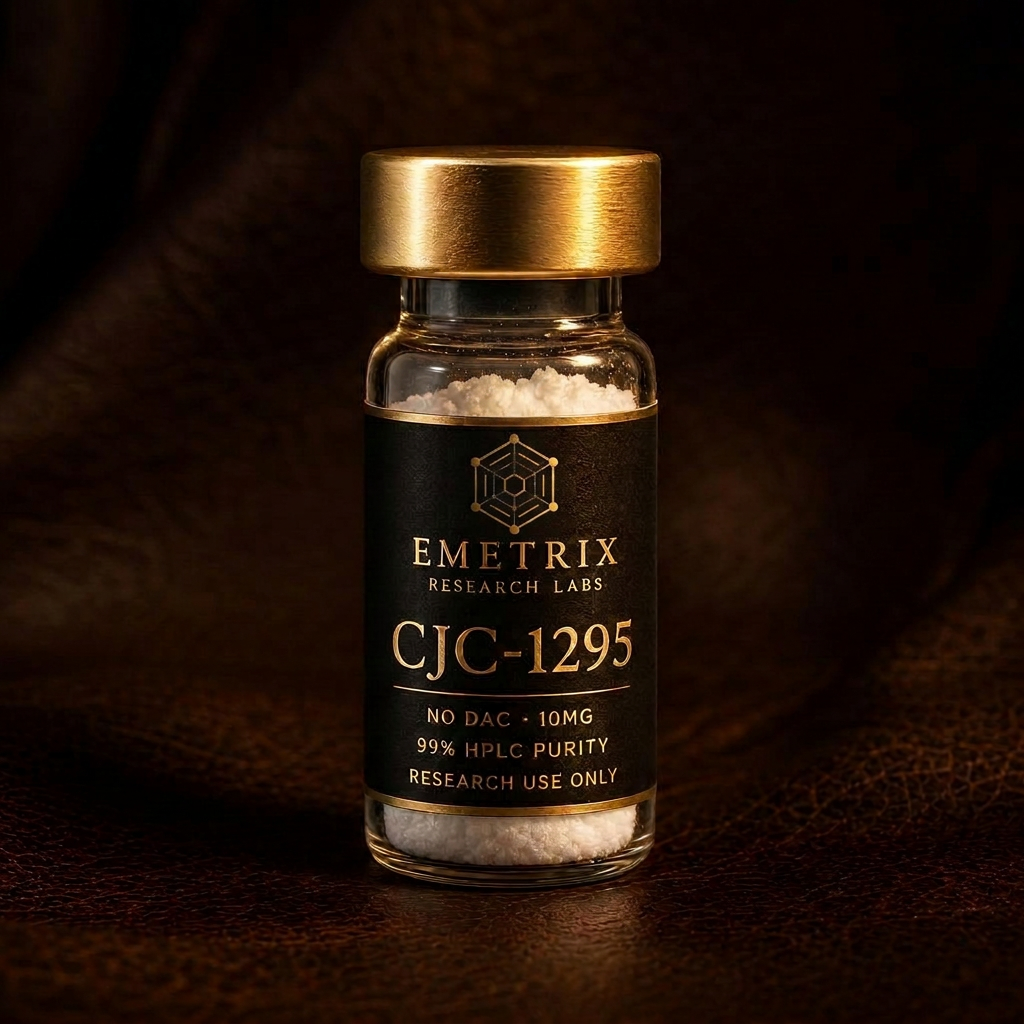
In its fully modified form, CJC-1295 incorporates a reactive chemical moiety known as the Drug Affinity Complex (DAC). The DAC moiety comprises a maleimidopropionic acid linker covalently bound to the Lysine residue at position 30. This structural addition enables the peptide to form a stable, covalent bioconjugate with nucleophilic sulfhydryl groups on circulating serum albumin (specifically Cys34) following exposure to plasma. The resulting macromolecular complex insulates the peptide against clearance and proteolysis, extending its terminal elimination half-life to several days. Research literature distinguishes between CJC-1295 with DAC (the bioconjugating long-acting form) and CJC-1295 without DAC (frequently designated as Modified GRF 1-29), which lacks the bioconjugating linker and displays a significantly shorter kinetic window.
Receptor Kinetics and Signaling Mechanisms
CJC-1295 functions as a selective agonist at the GHRH receptor (GHRHR), a Class B G-protein-coupled receptor primarily expressed on the plasma membranes of anterior pituitary somatotrophs. Receptor activation initiates a classical intracellular cascade:
- Heterotrimeric G-Protein Coupling: Binding of CJC-1295 to the extracellular domain of GHRHR induces a conformational change that promotes GDP-to-GTP exchange on the Gs alpha subunit.
- Adenylyl Cyclase Activation: The active Gs alpha subunit dissociates to stimulate membrane-bound adenylyl cyclase, driving the intracellular conversion of adenosine triphosphate (ATP) to cyclic adenosine monophosphate (cAMP).
- Protein Kinase A Activation: Elevated cAMP levels activate Protein Kinase A (PKA), leading to the phosphorylation of specific target proteins, including the cAMP response element-binding protein (CREB).
- Gene Expression and Exocytosis: Translocation of phosphorylated CREB to the nucleus enhances the transcription of the POU1F1 (Pit-1) factor and the GH gene. Concurrently, PKA activation facilitates the opening of L-type voltage-gated calcium channels, promoting calcium influx and triggering the exocytosis of pre-stored GH secretory vesicles.
Because the albumin-bound form of CJC-1295 maintains continuous engagement with pituitary receptors, it fundamentally alters the temporal dynamics of somatotroph stimulation. Rather than inducing short-duration, transient spikes in GH output characteristic of native GHRH, CJC-1295 promotes a elevated baseline of GH release while maintaining the relative amplitude of endogenous, pulse-generated GH secretions.
Reported Findings in Preclinical Models
Preclinical models evaluating CJC-1295 have centered on its capacity to sustainedly activate the somatotropic axis and downstream biochemical pathways.
Endocrine Dynamics and IGF-1 Elevation
In animal models, administration of CJC-1295 produces sustained elevations in circulating growth hormone concentrations. Downstream from pituitary stimulation, continuous GH signaling at hepatic GHR receptors induces transcription and secretion of Insulin-like Growth Factor 1 (IGF-1). Experimental data indicate that a single administration of CJC-1295 with DAC elevates systemic IGF-1 concentrations for extended periods (up to 7–14 days in specific mammalian models), accompanied by increases in IGF-binding protein 3 (IGFBP-3).
Metabolic and Anabolic Markers
In Preclinical investigations assessing nitrogen retention and body composition, extended GHRH receptor signaling by CJC-1295 has been associated with:
- Enhanced Protein Accretion: Increased incorporation of amino acids into skeletal muscle tissue in vivo.
- Lipid Metabolism Regulation: Elevation of basal lipolysis via GH-mediated downregulation of lipoprotein lipase activity in adipose tissue.
- Chondrocyte and Osseous Activity: Increased markers of bone turnover and collagen synthesis, secondary to elevated systemic and local IGF-1 expression.
Critically, studies note that despite continuous exposure to the agonist, somatotroph responsiveness is largely preserved. Pituitary tissue retains sensitivity to endogenous feedback loops, such as somatostatin-mediated inhibition, preventing total depletion of pituitary GH reserves.
Research Considerations and Methodological Limitations
When utilizing CJC-1295 in experimental designs, several methodological factors require control:
- Distinction of Variants: Researchers must clearly differentiate between CJC-1295 with DAC and Modified GRF (1-29). Experimental outcomes regarding clearance rates, receptor desensitization, and steady-state kinetics vary drastically between the two structures.
- Species-Specific Pharmacokinetics: The half-life extension of CJC-1295 DAC relies on binding capacity and half-life of host serum albumin. Because albumin turnover rates vary significantly across species (e.g., rodents versus non-human primates), pharmacokinetic parameters cannot be directly extrapolated across different animal models.
- Assay Interference: High concentrations of circulating albumin-bound peptide can complicate standard radioimmunoassays (RIA) or enzyme-linked immunosorbent assays (ELISA) designed to measure free GHRH or uncomplexed peptides, necessitating specialized mass spectrometry (LC-MS/MS) methodologies for precise quantification.
Research-Only Status and Compliance
CJC-1295 is an investigational compound designated strictly for scientific research and development purposes. It is strictly constrained to in vitro laboratory experiments and animal research models. CJC-1295 is not approved for medical, diagnostic, therapeutic, or clinical use, and must not be administered to humans or used as a drug, food additive, or household chemical. All handling must adhere to standard chemical safety protocol and institutional safety procedures within qualified laboratory settings.
Related products